Their bloody myspace page is the first thing I go to when I turn on the computer. Can't get enough of "Just a Substitute" and "Broccolli" aint bad either. Quirky, funky, fun--great for my last day of work before break.
Check it
Thursday, March 16, 2006

Saturday, March 11, 2006
Heir to the Throne
 A coupla months ago I did an interview with Damian Marley for Heads...I'm, as usual, too lazy to transcribe extra stuff at the moment (sorry Wayne!), but, so you know, Marley had a lot of interesting stuff to say about his trip to Ethiopia for the big concert in Meskel Square last year. When I was in Lalibela this January, the guide that took our volunteer group around the insanely awesome and amazing churches was the same fellow that took the Marleys around...the guide said that the famous family were lovely people, but he didn't understand the whole Rasta thing. "Why do they love Selassie so much?" he asked me, "Why not Menelik II? He was the one that fought and won against the Italians. Selassie needed help from England. I don't think God would need help from England." Too bad I couldn't have asked Damian that question...anyhoo, hope you enjoy:
 Not only did Damian Marley’s Welcome to Jamrock become the highest selling American reggae debut when it was released this past September, it contained possibly one of the most catchy reggae tunes since “It Wasn’t Me”. This time, however, unlike Shaggy’s sexcapade shlock, the title track off Marley’s third album speaks of “political violence” and “sufferation”. Bob Marley’s youngest son riles against lying politicians who “trick we” and the tourists who sit “on the beach with a few club sodas” while “poor people dead at random”. This is hardly a good time gal tune.
Damian, who worked on the record alongside his brother, Stephen, has created a fourteen song album that, unlike many reggae records, is remarkable for its versatility and consistency. Working with many US artists as well as Jamaican mainstays, Welcome to Jamrock demonstrates that this Marley is hardly trailing on his father’s coattails and lives up to his nickname: “Junior Gong.” It is certainly refreshing to know that a voice that doesn’t shrink from difficult issues is being heard in the international pop music scene. In conversation, he is open about his privileged past, his faith, and his love of reggae music.
EM: As Bob Marley’s son, someone who was raised with Rastafari, how do you feel that your faith affects your music?
DM: My faith affect everything that I do. Music is just another thing in my life that my faith affect. It affect the way I think, walk, eat...
EM: And for those people who own Bob Marley Legend and understand nothing about Rastafari save for dreadlocks and marijuana, what would you like them to know about your faith?
DM: You know, that’s the first step. Learning about those things that you see physically: the locks and the marijuana, but there is something much higher there that you don’t see unless you take the time to investigate it. Rasta is a really free way of life, it’s not really a religion. It is a way of life where everyone is still his own. The common thing with all of us is we see Haile Selassie I the First of Ethiopia as the manifestation of the Almighty in flesh, the reincarnation of Christ. That is the basic philosophy that all Rastas share, outside of that it is to each his own.
EM: You’ve worked with Capleton, another Rasta, and I know that he is a tremendously controversial artist outside of Jamaica and within Jamaica as well. What do you think about this controversy that seems to divide Jamaicans from the West in terms of views on homosexuality? What do you think would be the best way to move ahead in terms of the conflict that is happening?
DM: Well, there is a lot of things that we can talk about in a song. Each one express themselves, how they feel. Each one is opinionated. With Capleton music, he state his opinion very firmly and some agree and some don’t agree. Those who don’t agree take an action against him. At the end of the day it is up to every individual and if Capleton is comfortable with that, if he wants to stand strong on his point. If he feels good doing that, that’s what’s good for him. But there’s a lot of things we can talk about other than homosexuals.
EM: Where you are concerned, you often say that you’re a dancehall artist, but your biggest tune has a strong roots feel.
DM: There’s really no difference. Dancehall is a place, it is what is played in that place.
EM: I’m so glad you’re saying this!
DM: What we now call “roots”, in the 70s is what was dancehall music. It’s only now that you really try and differentiate it because the newer stuff is fast tempo and it’s programmed by drum machines instead of people in life. But it’s all part of reggae culture. Reggae culture is one. Because most artists that you hear on dancehall riddims, you also hear them on roots riddims.
EM: Exactly.
DM: You seldom have one artist who is just on one kind of riddim. We all share.
EM: Do you think that the more popular that Jamaican musicians get internationally, the more important it becomes for people to understand the way music is played in Jamaica—the fact that the dancehall is a space where different types of music are played and not just a genre of music?
DM: Educating people about reggae music benefits all of us. Reggae culture is a culture, not just a type of music; it is almost a way of life. Right now we are definitely educating the people to all that. Especially over the last two years. There is a lot of versatility coming out of our music: you have Sean [Paul] and you have someone like me and you have I-Wayne and you have original riddim like dropleaf. Definitely a one drop riddim with a whole heap a nice tunes showcased, we getting a lotta play from that. So right now America is really getting a taste of all the different outlets that reggae has to offer in terms of the fast tempo, the roots sound, you know what I mean?
EM: On your album, you share production credits with your brother, and you’ve worked with a lot of American artists. The track with Nas is great, and the track with Bobby Brown is surprisingly good given that a lot of us have not heard from him in quite some time. Do you have any plans to work with other producers?
DM: For the most part really over the years we have been keeping our production in house. We’ve kind of developed a likkle sound and a likkle formula of how to work.
Me and my brother make a good team. I’m not really in search of outside producers. On the other hand, if the opportunity came along and I heard some music that I loved, that I wanted to be a part of, I wouldn’t hesitate. This is not to say that I am thinking about going to work with other producers—I’m happy with the way we do things.
EM: Do you do many dubplates?
DM: Yeah, I do dubplates.
EM: A lot must be asking you for “Jamrock”. Those must get a lot of forwards.
DM: Yeah. (laughs)
EM: As someone who really liked the single “More Justice” off Half Way Tree, it’s seems that whereas in that tune you are speaking to Jamaicans, with “Welcome to Jamrock” you start speaking to the international community.
DM: Our family always has songs that have these kind of lyrical themes. We have made music that is political or revolutionary or whatever you want to call it. We always stand up for those who are voiceless. With “More Justice” it’s more like speaking to people in Jamaica. “Jamrock” is more like speaking on behalf of the people of Jamaica.
EM: What do you think that the international community needs to know about what is happening in Jamaica?
DM: Well, the international community just needs to know about what’s going on everywhere else aside from their own community, not just about what’s going on in Jamaica. It about we the citizens of earth taking responsibility for it. In “Jamrock”, it’s not really about Jamaica alone, it’s the same situation in most ghettos everywhere. So it’s really to try and get people active to help one and other, especially those who are elected to do that duty. To get them active at the community level and things like that.
EM: In terms of where you are speaking from, for those who’ve been to Kingston, they realize that Halfway Tree is not just the name of your album, but it’s also the divide between uptown and downtown
DM: Yeah, that’s true.
EM: Although some might argue that Crossroads might be the middle point...Anyhow, you have admitted that you grew up in a comfortable way, you had money, went to a good school, but I know that when you listen to dancehall there is a real sense of it having come from the ghetto communities. Do you feel you are speaking for different groups of people? What is your relationship to these communities of uptown and downtown?
DM: The ghetto is very much a part of my roots though I haven’t spent a lot of time there. But at the same time, like I say, it’s where the root is coming from. So we have a lot of bredren and extended family that come from there also. So a lot of the time, we are expressing the feelings of these people. I mean really, it’s not that complicated of a situation if you really check it. Jamaica’s a small place. Unless you are a person who like to seclude yourself, and that is the only way you don’t know what is going on there. In this world that we are living in you can turn on CNN and see what is going on a million miles away let alone to know what is going on in your own country. So it’s not really something you have to search hard far or something that because I didn’t grow up that way doesn’t mean that I wasn’t exposed to seeing what that life is. And the bottom line is that nobody should have to suffer.
EM: Being here in North America and having been to Jamaica, you see people who are uptown or who have money who don’t want to look at what’s happening downtown or in poorer countries. Do you feel that yourself, growing up in a situation where you were comfortable, do you think that you can act as a role model for other people who may be in the same situation as you but may not want to see that?
DM: Definitely. I think that I can be an example in the sense that I grew up uptown but I can see what’s happening. I can acknowledge it by trying to help or trying be a voice. Why shouldn’t others from where I’m from be able to do that too?
Thursday, March 02, 2006
The Joy of Hosen

Ahh, fun, fun, fun. That's what I'll be having next week on Thursday at Zoobizarre between 7-10pm. You should too. Anyhoo, I wrote about what'll be going on in this week's Mirror. Check it out.
Read more! Support good stuff!
Lederhosen Lucil
Mudscout Media
Friday, February 24, 2006
Pure Ghetto Story
 One of the most fun interviews I've ever done, Baby Cham impressed me with his on point commentary. Smart man, this fellow. No wonder "Ghetto Story" is running the place right now. I've apparently lost the unedited version on the abyss that is my computer, so here's what appeared in the Mirror.
Baby Cham’s recent single, “Ghetto Story”, is a hit. It’s the kind of tune that gets licked back four or five times. But this isn’t a surprise—the baby-faced man with the gruff voice has been responsible for tunes that having been running the dancehall for quite some time. Touring in support of his new record, a double-album collection of hits and new tracks—some experimenting with hip hop and R&B—Baby Cham challenged the Mirror’s credibility, discussed getting a break in the cut-throat reggae industry, and commented on Jamaican politics, all from his hotel room in Poughkeepsie, New York.
M: I’ve heard that one of your big influences is Major Worries.
BC: (laughs) How has a girl like you heard of Major Worries?
M: I’m a pretty big fan of King Jammy’s.
BC: Oh, I see, okay.
M: You must be into the 80s sound as well.
BC: That’s where I got my love for dancehall music. My uncle had a soundsystem back in the 80s: Studio Mix. They were King Jammy’s competitors in Waterhouse. Supercat used to deejay on the sound, John Wayne. Just by being there on a day to day basis, watching them do their thing, that alone influenced me over the years.
M: To me, you’re really a pure deejay. How would you describe your style?
BC; I would say that I’m a lyricist, someone that speaks of what’s going on around them. I write about real stuff that happen, not just fiction. In terms of deejay technique, it’s like old school because I listened to so much of that Major Worries and back then, but it’s with a new school flavour, a 2020 flavour.
M: You got started on this pretty young—scrounging up cash to take the bus down to the studios and tagging along behind Spragga Benz.
BC: (laughs) Definitely [being at the studio] was the most important part of trying to get a break. Now it’s different because so much kids have Protools sessions just by having a lap top or a computer at home. So you find that every house have a computer, every house have a studio. Back then you had to be going in to the Jammy’s, the Penthouse. I used to get up at 6am and catch the bus with my mom when she was going to work. I’d reach Penthouse by about 7:30 and I’d be just there until 10 in the night. Just waiting, waiting, waiting. Because you never know when you’re gonna see Dave Kelly in a good mood.
M: And you had to wait a while for Dave Kelly?
BC: Yeah. Back then I didn’t understand. I was like, if you know that I have talent, why wouldn’t you record me? But he wouldn’t record me until I finished school. Now I give him all the credit because I know he understand the importance of finishing school.
M: When you write about your experiences, you have been known to talk about politics, more specifically politics in Kingston—which is something a lot of people don’t like to talk about.
BC: I hate politics. For Kingston in the main, but Jamaica as a whole. If you live where I grow up, you can’t vote for the next team. I grow up in a JLP (Jamaican Labour Party) area which is Sherlock crescent. That’s green, and a PNP (People’s National Party) would be red. So, if you thought that JLP wasn’t doing the country right, you couldn’t vote for the opposite. Your parents, you, would have to move. That’s why I grew up hating politics. Most of my friends lost their lives, over nothing, politics. When you begin to understand the whole purpose of voting, what it means, for a party, what effect that has on your life, you realize that how it is running in Jamaica couldn’t be right. Politics in Jamaica is not just voting and that, it is a total different thing, people don’t get that, don’t live in Jamaica. It’s one of the main reasons for the violence and the crime rate.
M: Do you think that it is something that, as a deejay, you can do something by speaking out about it?
BC: If I wasn’t an artist, I know I wouldn’t be supporting politics anyway, but I wouldn’t have a medium to speak about it. You have so many kids out there that don’t want to be a part of it, but it seems like it’s cool, they will just ride with it. But if they hear a Baby Cham saying “Jamaica get screwed threw greed an glutten, politics manipulate an press yutes button”, they might think “I’m not going to get involved, that bad mind ting.”
Friday, February 17, 2006
Who caan stop wi?

Yesterday I hosted a special one-off episode of Venus on CKUT 90.3fm here in Mtl. It was a special on women in reggae featuring studio one tunes, a nice dose of sugary lovers rock, some hardcore dancehall, and much more nice stuff including interviews with Marcia Griffiths and Tanya Stephens.
The show was on from 12-2pm yesterday (Feb 16) but you can still listen online for the next few weeks or so by downloading the program from the CKUT website here:
http://secure.ckut.ca/cgi-bin/ckut-grid.pl
Click on "Venus" -- 12-2pm, Thursdays.
I'd like to thank Anna of Venus for inviting me on, Jah Mikes for helping with the mixes, and everyone who called in with kudos. That was very nice.
I'd be interested in hearing what you internet folk think (the 4 people who read this blog, that is) about the show.
Enjoy!
Wednesday, February 01, 2006
Tenayostalin!

I am back from Ethiopia where I was leading some folks in that house buildin' volunteer stuff I like to do. It was, not surprisingly, amazing, enriching, and life affirming. My Amharic has improved (tenayostalin, btw, simply means "hello") and I was able to give a speech in the language to the lovely people in Debre Birhan--a town about 130km due north of Addis Ababa. This was apparently quite impressive (or, probably, hilarious) because they taped the speech and sent it around the country for people to hear.
Anyhow, the above picture was taken at the Rasta school located in Shashamene, Ethiopia (notice the red, green and gold epaulletes on the khaki uniforms--looks like Luciano might have designed it). The Jamaican Rastafarian Development Committee (JRDC) is doing an amazing job. Ethiopians in general are a bit wary of the whole Haile-Selassie-being-God thang, but the school doesn't overtly preach the faith and offers fully-sponsored, high quality education to children from not just the Rasta community, but the community of Shashamene as a whole. Presently they have 451 students enrolled in grades K-10. I can't over blow how terrific their fascilities are. Not only is the school new, clean, and bright, but the classes are not of the gigantic size you normally see in Ethiopia's government-run public schools (which require user fees, incidentally). They have a nice library and computers available for the students--not to mention the brand-new teaching aids available for teachers to use. Young Ethiopian teachers are given a chance at the school, so it makes for a dynamic environment. As a teacher myself, I was so pleased to see this school (which I had initially visited during its construction last year) up and running, full of smiling, engaged (and engaging) students.
Of course, as anyone who knows me realizes, I'm more than a little interested in the clash/connection between Rasta and Ethiopian cultures that happens in Shashamene, and in the rest of Ethiopia (among other intersections between Rastafari and other cultural groups such as, say, my own). I hope to return this summer and attend the birthday celebration of His Imperial Majesty--a festival that is open to the public...I hear there just may be a soundsystem and some ackee and saltfish served. Fun.
On my way to Ethiopia I read the following article in the NYT. I'd read Maya Angelou's All God's Children Need Travelling Shoes recently and it was interesting to read a present day take on the return of the African diaspora to Ghana. It's quite different than the return of the Rastas to the promised land, but I wonder about some of the comparisons that could be made...(sorry that it requires that whole registration fiasco)
Ghana's Uneasy Embrace of Slavery's Diaspora
Sunday, January 01, 2006
Some of you might be interested...

My top stuff of the year as seen in the Montreal Mirror:
Top 10 albums
Junior Kelly-Tough Life (VP)
Common-Be (Geffen)
Warrior King-Hold the Faith (VP)
Fantan Mojah-Hail the King (Greensleeves)
Linton Kwesi Johnson-Live in Paris (Wrasse)
Platinum Pied Pipers-Triple P (Ubiquity)
Lady Sovereign-Vertically Challenged EP (Chocolate Industries)
Wolf Parade-Apologies to the Queen Mary (Sub Pop)
Jah Cure-Freedom Blues (VP)
Konono No. 1-Congotronics (Crammed)
Bottom 3 albums
Rihanna-Music of the Sun (Def Jam)
Shaggy-Clothes Drop (Geffen)
LMS-London 2 Paris (VP)
Best song: Gyptian “Serious Times”
Worst song: Shaggy “Wild 2 Nite”
Best show: Capleton, Studio, Oct. 7
Worst show: Lady Sovereign, la Tulipe, Dec. 2
“Capleton was seriously one of the best shows ever—the fire alarm ringing was the icing on the cake. I love Wolf Parade as much as the next Mile-Ender, but the lack of flamethrowers at their shows is unfortunate. For next year, I’d like to see more outdoor reggae events (hello, Piknic Electronik!), more corn soup sold outside clubs (ital food after Beenie Man was nice), and less shows ending at 9:45 (why, la Tulipe, why?).”
Saturday, December 03, 2005
King of the Dancehall
 Here's a version of the piece I wrote for the Montreal Mirror this week. I'll try and work up a take with more info--I spoke to Beenie Man for a while, so I gots a lot more stuff, though some of it is somewhat confusing and bizarre.
Beenie Man, born Moses Davis, is one of the more controversial and confusing characters in the Jamaican music industry. Demonised internationally for his hateful homophobic attitudes, adored and hailed as a ghetto success story in Jamaica, and embraced by producers, performers, fans and the Grammy awards in America, the one-time “boy wonder” has apologised for his offensive lyrics, but he’s also craftily maintained his stance in yard. Though he’s tough to pin down—and whether a man who refers to himself as a “Grindacologist” can really take a moralistic stance à la Capleton is an open question—there’s no doubt that Beenie Man has cranked out some of the most entertaining and engaging dancehall tunes ever. And thankfully, those, as opposed to the few negative tunes, are what he’s known for. Want proof? Two words: zim zimma. The Mirror caught up with him at his recording studio where he was working on a new album.
M: For your new album are you going to stick with more of a serious dancehall feel like you did with Back To Basics?
BM: Yeah.
M: On Tropical Storm you worked with the Neptunes and Janet Jackson—it was very internationally focused. Do you think that the international audience is ready for dancehall?
BM: The problem is, you have to give it to dem until they ready fi it. Because dem never ready fi rap music either: gangsta rap or all of dem tings dem, until gangsta rap becomes the biggest music in America, seen? So it’s for us to feed dem the dancehall music until dem becomes familiar. It’s not like everyone in America speaking Spanish and look at it: reggaeton is big, yuh know? If dancehall make that music, then dancehall can make it.
M: You’ve been involved in reggae since you were a youth.
BM: Since five.
M: And you’re coming from Waterhouse, a famous area for music in Kingston. I was wondering if you could tell me what the influence of King Jammy’s and the Waterhouse sound was on you.
BM: I was before King Jammy’s. My uncle used to own a sound call “Master Blaster”. It when Jammy was engineer at King Tubby’s studio. Tullo T, Pompidou, John Wayne, all of these artists didn’t really have a chance. From that day now den Jammy’s, pick up di dancehall ting den. Him becomes an international dancehall sound. It was like a highlight of his influence towards the music, but there was good music before Jammy’s sound. Jammy’s give wi a chance to go out there so people can know the product of Waterhouse artists. Wi respect Jammy for that. He never give us no influence or nothing, we influence him fi build a sound. Him live in a government house and him have an 8-track machine, that before him become King Jammy.
M: So you’ve seen the music develop.
BM: Jamaican music start get recognized now, seen? Sean Paul sell five million, Shaggy sell, what, 30 million?
M: And now Damian Marley.
BM: Selling a lot, so you dun know, dancehall is there.
M: But a lot of people see dancehall as being all gal tunes, gun tunes...how do you define dancehall?
BM: Dancehall music is the authenticness of Jamaicans and the militancy of Jamaicans. That’s what it is, because it represent the culture and nothing else, that’s what it is.
M: It allows people to talk about a lot of different things.
BM: Yes, it represent you. Everybody is not politician or writer for newspaper. You express yourself through the paper, I express myself through the music.
M: People have written about your lyrical battles with Bounty Killer and, more recently, your more literal battles with Capleton. Has this conflict been resolved?
BM: That was a long time ago, like three years ago. People still have grievance inna dem heart, but not mi. For mi it’s peace, that’s it.
M: Much like Capleton, you’ve received criticism for your lyrics. In fact, when I reviewed Back to Basics for the Montreal Mirror, I received criticism myself for having reviewed a record by someone who holds homophobic beliefs. How would you defend yourself?
BM: People just try to fight against the music, they’re not only just try to fight against mi, they’re try to fight against the music. I am the king of the dancehall. I am the one that can take the music to the level where it is, I am the one who can represent dancehall music like how Michael Jackson, him represent pop. Dem don’t want mi to reach that level. People ask mi this same question and I tell them that I am against man that have sex with little kids. I cannot be against man that have consensual sex. If two big man want to have sex, it’s their perogative, that’s my opinion. But if you try to get the likkle ghetto youth ‘cause dem nah have no money and dem come with the money and try to give to dem. That is what I am against. I tell that to di world.
M: So your problem is with pedophiles.
BM: Yes. My foundation is the Beenie Man Foundation for Troubled Youth. Some molested kids mi have inna mi foundation wi have fi deal with. We have fi fix dem mentally and physically, fi true.
M: And also, I know that here in Montreal and in Toronto, people are specifically worried about the violence in the music and how it affects young people.
BM: There’s no violence in di music man. Violence in people heart. That’s foolish, no violence in di music. Some write di baddest gun tune inna di world. Why? Because it in di imagination. People need to stop that, talking about violence and music. Music have no to do with violence.
M: Do you think that if people can talk about it in a song they won’t do it in real life?
BM: Simple. Violence is there; it’s a reality. Kids live what dem learn. Man is shot every day for nothing, police kill people, innocent people every day for nothing, That’s what they talk ‘bout.M: What do you think is the solution?
BM: I do community development. Everywhere violence is going on, I try to create a football competition, I try to create a football field, I try to create some work or a clean-up campaign. I try to get dem look at a mirror to see the reality of these tings, because these youth dem a shoot their own friends. So that is what I do. Then every year I keep up a free show, it cost like 3.7 Jamaican dollars to do it, but these people nah make millions of dollars a year. I invite all the top stars in Jamaica and di people who cannot afford to go to the Sting or the SumFest or the SunSplash can just come and enjoy themselves right here.
M: So if you act as selector and were going to drop a few tunes, what would you play for the people? And you can’t choose yourself!
BM: Well it depends on the vibes and di people dem, yuh know? Say you go to a dance and dem play riddims and di vibe it is dead. You try to lift up di crowd by playing dem more popular tune and then go from there. But if you in a dance where di vibes is more conscious so you go with Jah Cure, see mi a say, you try to keep it at a level so you cyaan really pick a tune the way they’re played. It’s a selector ting. You say “if” I am a selector—I’ve never flopped a dance before.
Sunday, November 20, 2005
Long time no writing
 I've been a neglectful blogger. That seems to be a bit of an ongoing theme here...I've been a titch busy. I will, however, be adding a few things in this space soon enough. There should (if all goes well) be a few new interviews. I spoke to Warrior King a couple of weeks ago and Damian Marley this past Wednesday. I've got a Beenie Man interview lined up, so, if all goes well, I'll provide some director's cuts for y'all to read.
Until then, you might want to take a look at my class blog. I teach West Indian Lit at Vanier college here in lovely Montreal, and I'm consistently impressed with my dear students. Although we call it CEGEP, it's really grade 12 and grade 13 + community college all thrown into the same building. It makes for some interesting classes and some vibrant discussions...
Check it out:
West Indian Lit
Friday, August 19, 2005

Saturday, July 09, 2005
How great is Tiombe Lockheart?
Ahh, how I like outdoor shows--bad sound be damned, I was just happy at Thursday's Platinum Pied Pipers Jazz Fest appearance to be standing around outdoors listing to great music, and by music I mean stuff I can dance to, and by stuff I can dance too, I mean stuff that sounds like this.
Wednesday, July 06, 2005
Nice up the Dance
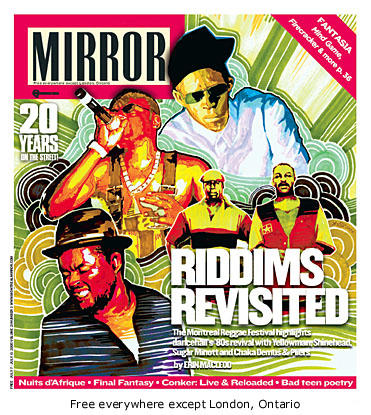
I've been a bad bad blogger. Sorry for the incredible delay in updating, but I've been a titch busy planning a trip to Guyana. Me and a group of terrific folks (I like that word, D, so there!) from all over this here continent will be going to that continent to work on a Habitat for Humanity building project. I'm the team leader-no laughing! I'm a competent individual. Honest!
In more musically related news, I wrote this week's Montreal Mirror cover story on 80s dancehall...hope you like. I had a great time talking to Yellowman. I mentioned Wayne's work on the Mad Mad riddim (if you haven't heard his radio programme dealing with the migration of the Mad Mad do so here, then here, and finally here. I played it for one of my classes and they were super impressed) and he was quite pleased to learn of the longevity of his "Zungguzungguguzungguzeng" melody and insisted that his style has been used for more commercial uses: "Sounds and words can put together and make something good. Even as simple as, look at Mazda they use a little bit of sound: 'zoom zoom zoom hey zoomzoomzoom' just like that, you know?" Whaddya think, Mr. Marshall?
Anyhow, if you wanna read about the changes in the dance from the 80s till today as seen by Shinehead, Chakademus and Pliers, Sugar Minott and King Yellow, check here.
Thursday, May 19, 2005
Yet another reason I need to plan a trip to London soon...
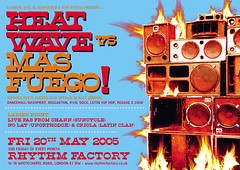
Anyhow, my point is that though I'm an idiot, there are most certainly some fine folks in London and some of them are throwing a special version of their already special regular party, Heatwave vs Mas Fuego. Along with the usual mish-mash of dancehall, reggaeton, r'n'b, soca, Latin hip hop, reggae and zouk courtesy of resident DJs Heatwave (Punchline Records), Lubi (Nascente Records) and MDK (Twice as Nice), we gots some women holding it down: Lady Chann (Suncycle - dancehall/bashment), Criola aka Gemini (Latin Clan - reggeaton/R'n'B), No Lay (Unorthodox - grime/garage) and DJ Lexy Lu (Rethink London).
C'mon, if Time Out says these folks are "exciting new luminaries", dontcha wanna be there? Just don't forget your shit on the tube on the way over to Whitechapel-I've got a feeling that Jah's probably tired of locating the personal effects of scatterbrained music fans.
Just in case you need directions:
Friday 20th May 2005 @ The Rhythm Factory
16-18 Whitechapel Road, London E1 1EW
Tube: Aldgate East / Whitechapel
Buses: 25, 205, 254, N25, N106, N205 & N254
9pm-4am > £5 before 11pm/NUS > £8 otherwise
Wednesday, May 04, 2005
Blood and Fire turns double digits
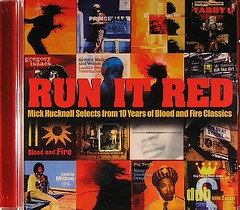
Blood and Fire, really and truly the best reggae reissue label in the world, turns 10 years old this year. To commemorate this momentous and wonderfully happy occasion, they've issued this terrific, King Tubby-heavy collection of tunes. You can check my review in the Montreal Mirror, and, in commemoration of this event, I thought I might as well dig an interview I did with Steve Barrow-one of the nicest fellows around. He and his family make sure I'm fed well whenever I'm in London. Anyhow, this was a great conversation and it's so much longer than what I'm going to post here. If you want the rest, just ask and I'll take the time to edit it enough so it's presentable-there's lots more good stuff-Steve talking about kids who listen to loud car stereos, how to pick the best punanny version, and the fact that he's not the biggest fan of Lee Perry. I'm a little low on time at the moment. Oh, and if you're interested in the Tree of Satta we're talking about and you don't already own it, run, don't walk. Seriously. It's wicked.
Originally published in Under Pressure magazine, August 2005.
Something sensible in the dance
One of the founders of renowned reggae label Blood and Fire, Sterve Barrow’s been behind the reissue of masterpieces like the Lee Perry-produced Heart of the
E: Do you think that today’s Jamaican music will last?
S: That’s a good question. Will people be playing Elephant Man in 20 years? Yeah, I think there will be a couple of tracks. There will be odd albums, tracks by Capleton, there will be the Black Woman and Child album from Sizzla, there will be the Real Revolutionary album from Anthony B—those albums are classic albums in any period and as good as anything from the 70s and better than a lot of the crap that was put out in the 70s that people don’t remember now. Will there be people collecting these records in 30 years time? I bet they fucking will. If people collect Smiths records, the worst deejay in
There are classic records being made like Luciano, and Jah
E: A lot of the glorification of the 70s results from believing what was around back then was fantastic, but there’s been years to sift through it. We just need to give time for 80s and 90s reggae to sink in . . . we need to figure out how to listen to it. I’ve often thought that in order to appreciate this you need to appreciate the context. To understand the Sleng Teng, stand in front of a sound system playing it.
S: Yes. When you play it on a casio keyboard using some little preset, it’s sort of a take off of Eddie Cochrane more than anything else—some rock rhythm programmed. When you play it through a big sound like Jammy’s, it’s going to sound like a killer.
E: What led you to release Tree of Satta with the range of artists you chose?
S: I know that it’s a classic riddim. Having played the riddim track for the last 6 years—and I’ve had various people deejaying and singing on it—it’s an inspiring riddim. Everyone knows the song, it’s a standard. When Bernard Collins came to us with the project, he only had 14 cuts, so I said what about getting some new guys on it? Anthony B was my first choice and he’s someone that’s always impressed me out of the new artists. He’s better than a load of people from the 70s. Way better. It’s because he’s got more to say.
I had no idea he was going to record Natural Black and, sure he’s got a little bit of Buju in the deejay part, but he’s got a great hook on it. It was also good to get someone from the 80s like Tony Tuff. Bernard, I knew, would instinctively get good performances.
E: The Capleton track is absolutely incredible.
S: The Capleton is brilliant. “Dislocate” is real revolutionary lyrics except that what he’s offering as an alternative leadership is not, to me, going to take people very far on the road they need to go on, but then again, no form of idealism is going to take people very far these days. It’s going to be undermined and eroded by reality. If anything, Capleton corresponds to the zeitgeist. He’s a little more hysterical. And that reflects society. Society’s going hysterical. It’s just part of the craziness of the world.
E: And these musical forms enable people to discuss this stuff—to discuss society and other things that might not be possible otherwise. Shit like sexuality, politics, culture . . .
S: Exactly. That’s it. These artists raise an agenda that is totally excluded by modern social democracy. Modern social democracy says you can vote, you can have an opinion on these things once every four or five years, then the rest of the time, “Fuck off! We’re not interested. You want to protest, go ahead, we don’t give a fuck.”
E: If you are so convinced of the 70s as the best time in Jamaican music, it also means you are more interested in the music than the agenda that’s being raised—because if you are interested in what’s happening in a nation like Jamaica, then you’ve gotta be interested in stuff that people are saying now, 5 years ago, 10 years ago, any time since the 70s.
S: Yes. Some of the people I sell records to thought that by having Capleton on a Blood and Fire release it was a big betrayal. But if I want to put Capleton on a classic riddim via Bernard’s production ability, I’m going to do it, because I like Capleton. When I played “Dislocate” to Bunny Lee he said, ‘Steve, that one’s gone...it’s gonna kill people. You’ve done it again because you have the new on the old.’ Bunny Lee can see the mileage in that. He’s been doing it for years. That’s how it goes. People like Capleton and Anthony B and Sizzla have made their decision. They’re going to put out as much music as they can—10 a week if they can—because they’ve got things to say.
Most people have to punch a card in the West. They become a commuter, this that or the other. But they’ve all got a little ‘thing’ because that’s what keeps them sane. People do drastic things to establish their identity, stupid and silly things to get attention. People in the ex-colonial world get twice as little attention. They are doubly removed and women are trebly removed. It is all about a society that alienates and excludes, and that’s the society we live in. Music gives us a way of overcoming the alienation and saying I do mean something. I am somebody. If only for 2 and a half minutes. I don’t feel inclined to slag people off for jumping on a riddim track and saying some half-remembered Buju pattern or some Ninjaman business or whatever. If it gives them a reason to live, makes them be somebody, that’s what we need. We all need to be somebody. The problem is that the people who are somebodies really are nobodies.
E: And they don’t let anyone else take their turn.
S: Exactly. In a sense there is a certain therapeutic aspect to it. And that’s what music is anyway. I was watching a documentary on
Friday, April 29, 2005
Music you should hear
I've played this song for a couple of people and they've both quite liked it. I think it's got a little bit of a Magnetic Fields thang goin' on, and I'm partial to not only the lyrics, but the performer as well-after all, it is my dear runty brother. Comments are more than encouraged-they are demanded. They guy's gotta have some encouragement to play more outside of his bedroom.
There's more where this came from-if I can only figure out a better way to link mp3s to this page. At this point, you need to cut and paste the url-blogger won't allow for "deep linking". I don't even know what that means. Got suggestions? This computer illiterate is interested.
Third Look - Grant MacLeod
http://soundslikefun.blogdrive.com/mp3s/thirdlook.mp3
There's more where this came from-if I can only figure out a better way to link mp3s to this page. At this point, you need to cut and paste the url-blogger won't allow for "deep linking". I don't even know what that means. Got suggestions? This computer illiterate is interested.
Third Look - Grant MacLeod
http://soundslikefun.blogdrive.com/mp3s/thirdlook.mp3
Saturday, April 23, 2005
Yay Arcade Fire

See, I like stuff that isn't just reggae...
This was an interview published in the L Magazine (Vol. 1, #19, October 13-26, 2004), a cute, little pocket-sized magazine that's available for free in a place they call Brooklyn, New York. I wouldn't know, I've never been there. Anyhow, given that the Arcade Fire are playing tonight, tomorrow, and Monday, and that they're sorta popular now (Time magazine anyone?), I thought it might be as good a time as any to post it here.
When Ataris Catch Fire (Oh, Jon, why this as the headline?)
The Arcade Fire with Erin MacLeod
Folks love the Arcade Fire. They really, really love them. Their debut album, Funeral, has been out for a month and critics seem to melt into puddles of maudlin blather after listening to the first track. “Anthemic momentum,” “acoustic majesty,” reads the Pitchfork review. “It takes a band like Arcade Fire to remind you that we are all custodians of our innocence and that we let it die at our peril,” writes some guy in the Globe and Mail. This is all a little much for a not-so-little band from
EM: Your Montreal CD launch was pretty nuts—a thousand indie rock fans packed into a church. How can other venues compare?
RC: It’s just about the people. The place can influence the overall feeling, but it’s just about being in front of people and singing your songs.
EM: Do you see it as more of a performance? There’s definitely a titch of theatricality.
RC: There’s two ways of seeing the word ‘theatrical’. The Broadway style that is put on; you invent something, you make it up. But this is not what we are trying to do, which is a little more scary. Because you’re not really pretending and so it can become really intense and weird.
EM: Most of your songs are pretty intense and don’t really build—they kinda start at a climax.
RC: I guess when we write songs it’s what comes out of me. And it definitely has something to do with what I’m living, my society.
EM: Have you read any of the reviews? Because they’re a little more than positive. How do you feel about the fact that people are writing about being moved spiritually by the Arcade Fire?
RC: (laughs) Depends on the day. I think to myself, ‘What? What are you talking about?’ But it’s all out of our control. I don’t do anything different from last month. And I don’t understand. Now it’s just a weird thing of something really personal being really public. When we write those songs we don’t think about all this.
EM: What do you think about the comparisons made between you an Broken Social Scene, Polyphonic Spree, Talking Heads, Debussy, Echo and the Bunnymen, New Order, I could go on...
RC: A lot of people say we’re like Broken Social Scene. I understand that people think that one of our songs sounds like [them]. It does sound like the beginning of one of their songs. Win wrote that song in 1998, 1997, when he was in high school. It’s like this game of trying to find, which is kind of annoying. I don’t want it. If you don’t like it, it’s fine, if you do like it, come hear it, that’s great.
EM: Some have said that you’re part of some new Canadian or
RC: It’s a weird human thing to try to make sense of what you see by putting it in categories. It’s like a human reaction. But it’s not like we planned. We’re not like ‘Hey guys, hey Unicorns, hey Wolf Parade, we’re gonna start this thing.’ It’s more, ‘what are you talking about?’
EM: Do you see yourselves as a Canadian band?
RC: It doesn’t matter. I mean people look at me and try to categorize—oh she’s a woman, she has Haitian roots. But it’s really not important. It’s not about being Canadian or Quebeckers.
EM: You’ve got Texans, Vancouverites, Montrealers...Are you planning on keeping the line up the same, because it’s changed so many times.
RC: Oh yes. It’s just how life goes, sometime it changes things happen. It’s like do you wish to have eight boyfriends be fore you find the one you want? Eight breakups? No. But things happen.
EM: Last year you played CMJ and opened for the Wrens, this year you’re headlining the Merge records showcase. This must be a big change for you guys.
RC: Last year, it’s like how are you supposed to go and see a band you’ve never heard before? It wasn’t a big surprise that there weren’t too many people. Now it seems like people have heard of it so there probably will be people, but it’s not really different from last year.
EM: You are headlining though. That must be somewhat exciting, no?
RC: I am excited. I just hope we can live with out all the superfluousity of being in a band because there’s a lot of crap that surrounds the whole thing. I hate the word “industry’, it’s awful.
EM: What would be the ideal situation for you a year from now?
RC: After we tour, me and Win, we want to go work and do something that’s unrelated to music. Like in some town, some community centre, somewhere in the world. I don’t know what. I don’t really wanna get caught it the crazy, crazy lifestyle of rock bands.
EM: Aren’t you looking at being away from home for quite sometime right now?
RC: Yeah. No wonder some artists get all fucked up. We haven’t experienced anything. We’re just starting. Things are coming at us and we need to deal with all of this. Sometimes it’s just like ‘Oh my god, what is this? This is weird this is strange.’ A lot of people ask ‘How do you feel about all this?’ And I’m like, because our name, the band is out there, it doesn’t mean that I’m out there. I’m still here, I’m just going home, going to bed. And it’s weird to think that people are talking about you, it’s kind of freaky.
EM: But are you having fun when you are playing?
RC: Oh, yeah.
EM: Because in all your pictures you are so serious.
RC: (Big sigh) I know, but of course I’m having fun.
Friday, April 22, 2005
My house is a mess, but there are certain silly things I'll spend hours doing
For some insane reason, I thought it would be a good idea to archive all of my reviews. I figure it'll make a nice keepsake for the kids.
Reviews Galore
Reviews Galore
Thursday, April 21, 2005
Dem Come Fi Mash Up
For all who check this space and might not live in lovely Montreal, you still might be interested in my piece this week on soundsystems in Montreal. I've checked the montrealdancehall.com message board a couple times today because I am convinced that I must have written something controversial (in someone's mind). Anyhow, I was fairly happy with the piece-though I wish it could've been longer so I would've had space for additional interviews. If you have any thoughts, I'd be thankful for any constructive criticism. And big thanks to Don Ignorance, Fatta, Mawga K , and Carolyn Cooper for their help. Also thanks to Jah Mikes, as always, for suggestions. Okay, before it sounds like I'm accepting an award (instead of introducing a silly article), enjoy.
Ring the Alarm
Oh, and for the British folks in the house, you might wanna check out the cover story on grime-ity grime grime.
Grime Time
Ring the Alarm
Oh, and for the British folks in the house, you might wanna check out the cover story on grime-ity grime grime.
Grime Time
Monday, April 18, 2005
The Empire Strikes Back

A year or so ago, someone sent me a link to the Empire Isis website. Based on the photos, my first reaction was to think of this as the Simple Life, Rastafari style. The description on their website referred to themselves as Miriam "911 aka the emergency line" and Madeleine "the M.A.D. madam". The two dreaded blondies had relocated to Brooklyn from Montreal and Morocco, though they'd supposedly travelled through 25 countries "investigating the untold stories of the underground scenes from Argentina to Canada". Oh, and they insisted in the Montreal Mirror that they "represent Africa, Jamaica, and Bedstuy". Pardon me, but give me strength.
The duo have apperently split; Madeleine, the non-joint-puffing girl above (a particularly lovely photo by Rachel Granofsky) seems to be, well, out of the picture at this point. Perhaps she came to her senses. Suffice it to say, on the website, M.A.D. madam has been photoshopped out of the cover of Hot24Seven magazine and there's a video that showcases concert and interview footage, carefully edited so as to avoid any glimpse of the girl. Last year they claimed to "speak and cypher" in five languages: Spanish, English, French, Portuguese and Patois, but I suppose the split required Miriam to double up on language duty as this list has expanded to include Arabic and Swahili.
Now, I shouldn't make so much fun, but it's hard to hold back a chuckle when you read stuff like "Isis dedicate this to all those ina yard/ though we know you sufferin’ and times is hard /keep your family tight it could never break apart / build a righteous government and get a fresh start” especially when it's coming from girls who, although cute, are more like Paris and Nicole than Sizzla. Sure, their (now her) album, which is set to be released this spring, features appearances by Half Pint, Bushman, and Dean Fraser, but in an industry in which anyone can get a dubplate cut if they simply cough up enough cash, it's tough for me to see this as proof of the street cred Empire Isis so desperately wants.
Maybe I'm wrong. To me they sound like they are trying desperately hard to prove themselves hardcore and the so-called "documentary footage" included in the online video of various reggae artists as well as Sizzla's Judgement Yard and other images of Jamaica looks more like glorified tourist videos. Where non-Jamaican reggae is concerned, Ms. Isis is hardly Zema or Mighty Crown or Gentleman or even Snow. Don't get me started about her/their attempts at reggaeton either. Then again, Empire Isis (the solo artist) is up against Brick&Lace, Mr. Easy, Chuck Fender, and I Wayne for the Most Promising Entertainer Award at the 24th annual International Reggae and World Music Awards to be held this May. I say it is a travesty to put over-the-top attempts at patois against someone like I Wayne, who is one of the most exciting singers to come out of Jamaica in years, but Fader magazine thinks that Ms. Miriam-the "Empress Gangstress"-is hot enough to deserve coverage in the next issue-or so the internet chatter tells me.
I know I should show more support-the girl is from my city and she clearly does have some gumption, but there's a whole lot of identity issues going on here. And frankly, the music just doesn't cut it. Period.

Ms. Empire Isis, the solo artist (poor Madeleine was probably in the other half of the picture-can't say I'm not curious to know what happened!)
Wednesday, April 06, 2005
Other Music I Like
I was asked this evening if there's any music I like apart from reggae-specifically dancehall. As an attempt to prove that I don't have a one track mind, I figure there's probably no better time like the present to give a little list (off the top of my head, clearly; it's a titch late) of tunes I like right now.
In the Morning - Omar
Hold it Down - 4Hero
Truth - Dwele
Come and Get Your Love - Redbone
Booty La La - Bugz in the Attic
Haiti - Arcade Fire
Postal Service - Against All Odds (Take a Look at Me Now)
Feel Like Making Love - D' Angelo
Do You Dig You - Q-Tip
Can't Help It - Michael Jackson (Todd Terje Re-edit)
Kiss of Life - Sade
Freak Scene - Dinosaur Jr.
100,000 Fireflies - Magnetic Fields
Rosalinda's Eyes - Billy Joel
and oh yes...
Could I Be Your Girl - Jann Arden
This is, of course, not a complete or comprehensive list. It would probably be the CD I make right now, if that was in the cards.
In the Morning - Omar
Hold it Down - 4Hero
Truth - Dwele
Come and Get Your Love - Redbone
Booty La La - Bugz in the Attic
Haiti - Arcade Fire
Postal Service - Against All Odds (Take a Look at Me Now)
Feel Like Making Love - D' Angelo
Do You Dig You - Q-Tip
Can't Help It - Michael Jackson (Todd Terje Re-edit)
Kiss of Life - Sade
Freak Scene - Dinosaur Jr.
100,000 Fireflies - Magnetic Fields
Rosalinda's Eyes - Billy Joel
and oh yes...
Could I Be Your Girl - Jann Arden
This is, of course, not a complete or comprehensive list. It would probably be the CD I make right now, if that was in the cards.
Subscribe to:
Posts (Atom)