Thursday, October 26, 2006

Holding the Faith
 The weather around these parts has been gosh-darned awful. I always find that in Montreal, when it's getting cold, it's hard to imagine that it will ever be warm again. Then, when it's blistering hot, it's near impossible to believe that piles of snow fall on this city every year. In order to keep faith in my Canadian ability to endure seasonal change and to keep myself from falling into seasonal depression, I've taken to thinking about Portmore, Jamaica. Portmore, right next to Kingston, is home to Hellshire Beach, the whitest sand and bluest water I've ever seen. Granted, I don't have much experience with beaches, but, in my mind, it's pretty wonderful. I also wouldn't mind having a freshly cooked fish with bammy and Red Stripe right about now as well.
EM: On your first album you sang a song about the value of education and on this new record there is also a tune that deals with the importance of education. This is clearly a big issue for you.
WK: Jamaica is in a state of turmoil right now, basically because of the lack of educated people and youth. Majority a lot of illiterate people are there. You have big people down there who are in their forties and they can’t read or even write. So it’s easy to resort to crime and violence. If someone is educated, they can reason out and come to some sort of reasoned terms, but someone who is not educated prefers to resort to violence. So this is exactly why they mash up the society. Education, as his majesty teaches us, is the key to betterment and completeness of living in this modern time. So as a servant of his majesty, we emphasize the importance of education, because education brings liberation. It’s good for every nation.
But, if you want a good education in Jamaica you have to have money. A lot of money. I never used to pay school fee, but now the parents have to pay school fee for primary school, basic school. I have a likkle son; me have to pay $6000-7000 Jamaican dollars a month. That’s just a normal, basic school. So you see, most people can’t afford that so it end up that the youths, the parents carry them to go work ‘pon the street side. In Jamaica you see a lot of youths at the stoplight, wiping glasses when they should be in school. You can’t put blame because their parents cannot afford it. They cannot buy books for them, they cannot buy uniform, they cannot pay school fee. They cannot afford the fare to send them to school. Education is the key for any nation’s development. That means education should be free. You haffi consider the poor.
EM: Clearly you feel this on a deeply personal level.
WK: Yes. You see, I had it rough. I was grown by a single parent, my mother. It was very rough, rough. And my mother haffi work, night and day to send me to school. So I didn’t waste time where education is concerned.
EM: You have spoken to youth—especially youth who are interested in the music industry—that it is important to stick with school to have a back up plan.
WK: The more educated you are, the better you are. Because, what I think is that nuff Jamaican artists have the attitude that they have because of illiteracy. They don’t know how to conduct themselves so that give them a bad attitude. Education makes you more rounded so you can deal with the interviews, relate to people more better—all levels of people, whether they come from uptown or downtown, no matter what category they come from.
EM: You’re coming from Portmore—the parish right next to Kingston, Jamaica. There are a number of artists coming from there recently—Gyptian, who won the Portmore talent contest last year and has a huge hit with “Serious Times”, and of course I Wayne. There seems to be a similarity between you and these other artists from Portmore in that you are all very concerned with consciousness. What do you think it is about Portmore that leads to the development of so many strong artists committed to conscious, thoughtful lyrics?
WK: Definitely, definitely, because you know there are many Rastafari in Portmore. So that stimulates the youth to come out with this type of vibe, you know? But at the same time, some youth see the culture and the vibes and they jump on the bandwagon too.
EM: But isn’t it better to jump on the bandwagon of cultural music than to jump on the bandwagon of less positive vibes?
WK: Ahh, definitely. Negativity is bad. But you know Portmore and Jamaica on a whole they have a lot of conscious people there: Bob Marley, the foundation, same way, you know what I mean? Peter Tosh and Dennis Brown and those artists, Luciano, Beres Hammond. They don’t rate violence so people know that positivity is the way.
EM: In terms of Portmore itself, you still live there and give back to the community.
WK: It is very important to remember where you are coming from. Although I was born in the country, in Clarendon, I moved from the country to Portmore. I moved to Kingston in my teenager stage. But it is very important to give back to the community that you are coming from. Cause your roots and your foundation that is. Right now, we come from Waterford and right now we have a youth we’re teaching him the right riddim, his name is Persistence, and he has a single coming out entitled “Foundation.” That’s a way to give back to the community, by helping some of the youths who have the potential too.
EM: Your music is very conscious. Do you think this trend is going to continue in Jamaica?
WK: It is not really continuing, I just speak a positive sound on a record. Whenever you hear that positive music is on the rise, it is always being recorded. It’s the people in the media you see. The media people highlight the vibes. They highlight the slackness and dem highlight the positive, you know what I mean? Positive music has always been recorded in Jamaica. Every since reggae music has been established in Jamaica, but it is the media, sometimes they don’t highlight the positive music but now, we see a lot of people highlighting the positive music which is good, but positive music has always been recorded and done in Jamaica.
EM: You just need to encourage people to pay attention to it.
WK: That is the thing; that is the thing.
EM: It seems that some people don’t like to record political music because of the potential for controversy.
WK: Everyone has the right to speak their mind. So they shouldn’t be afraid to deal with politics. Politics are realistical issues that need to be addressed. Reggae music that come from Bob Marley, it mention social issues. That’s the foundation of reggae music, that’s how it start out. Reggae artists address social issues where political issues are concerned or crime and violence are concerned. The condition of the roads or the condition of the country, definitely.
EM: Your faith obviously means a lot to you and I notice that on the cover of your album you have pictures of one of the carved rock churches in Lalibela, Ethiopia.
WK: Ethiopia gives the world all the religion that the world posseses. The three main religions: Christianity, Judaism and the Muslim faith, all of those religions came out of Ethiopia. So the foundation of the faith, where these religions started was Ethiopia, Africa. That is one of the reasons for highlighting the church. The church that is carved out of rock is a mystery to this day, like the pyramids.
EM: Having been to Ethiopia, I was made aware that the Ethiopian people are very nervous about the Rastafari, because they are very nervous about the use of marijuana.
WK: But not every Rastafarian use marijuana. Smoking marijuana does not make a Rasta. It’s not a rule or a regulation or a law because we have nuff Rastafarian bredren and sistren who do not smoke, who are firm in the faith, who have never smoked from the day they are born.
EM: I think that that is a misconception that many people have—that all Rastas smoke.
WK: The use of herb is a personal thing. It’s for meditation. The herb is not a fashion and style thing, it’s a sacrament for I and I still. In reality, a lot of youths smoke marijuana because they see Bob Marley smoke it in a lot of pictures or they see a lot of Rastafarians smoking herb but me wan fi tell them say: “If you smoke the herb then you have to smoke the herb and think positive.” But don’t smoke the herb or over use it because herb is not something you should abuse, because anything you abuse can be dangerous to your health. If you drink too much water, if you sleep too much, if you have too much sex, if you eat too much, everything that you overdo can be dangerous to you. But there is a balance in everything, you have to reach it.
Tuesday, October 24, 2006
Cleaning House
I've decided to clean up my computer...this, however, is the equivalent of revisiting the person I was a good near decade ago. I don't even recall why I wrote the following "journal entry", but man oh man, I'm a nerd.
Check it:
I went and saw Broadcast and the Sea and Cake last night. Since both bands have been referred to as “post-rock”, I thought it might be a worthy topic for my journal. It is really hard to define the whole genre of post rock. When I was working at Shift this summer, one of my colleagues was desperate to figure out just what exactly post-rock was. It became a bit of a project for everyone in the office. Although we could give her a list of bands: Gastr del soul, godspeed you black emperor, Do Make Say Think, Dylan Group, To Roccoco Rot, Mouse on Mars, Palace, Stereolab, Tortoise…I could go on, it was virtually impossible to define post-rock in any coherent way. I suppose this resistance to categorization could be viewed as somewhat postmodern and maybe that’s what makes a band post-rock. Interestingly though, I remember Patti Schmidt, host of CBC's terrific late night show Brave New Waves chracterizing a lot of this stuff as incredibly earnest. All of these bands are really serious about making art as opposed to music. These bands are quite somber and don’t seem to be having a great deal of fun, she was saying. There is also a lot less cynicism involved than in, say, punk rock.
What I noticed last night, particularly in Broadcast’s set, was a desire to layer—not just sounds, but images as well. They used no spotlights, but instead had an amazing film projected on a screen behind them. It was, actually, two projectors that had been set up to overlap. The films had evidently been pieced together out of old educational films and the effect was pretty spectacular. There was a particularly experimental bent to Broadcast’s performance and as I watched the performance I was able to set out somewhat of a definition of post-rock in my mind. Post-rock can not accurately be called a label in the same way “roots reggae” or “SoCal punk” are able to indicate a certain sound. Instead, post-rock indicates an attitude—perhaps even a theoretical model for music making. Each of the bands I mentioned above (and you could probably lump Radiohead in there too for good measure) seem to view music making as something that should be informed by a postmodern understanding of the world. I don’t think it is a coincidence that some critics refer to the stuff as “grad school rock”.
Friday, October 20, 2006
Love a reggae beat 'cause it's so...

Well, it's finally out and in print. Tell me what you think. I also have a couple of other stories in the paper...
Riddim Rulers
Cool Shul
Wednesday, October 18, 2006
"You may not live to play with them again..."
Okay, so England has the most frightening public service announcement films ever. There is nothing like threatening death to make children behave. In addition, some of the films point out dangers I never even knew existed--a carpet on a polished floor clearly equals death trap, as does a stool. Thanks to Dave, who introduced me to this series of harrowing, fear-inducing classics. Oh, and the music for these things is just as classic.
Sunday, October 15, 2006
Now I know how L.Lo feels
Monday, October 09, 2006
Little Brother makes me laugh a whole lot.

Asalaam alaykum, ye Harar conjo...
I found this video, shot in Harar, for a tune by Bole2Harlem (so named for Bole Road--the road that leads to the airport in Addis Abeba). You may or may not like the song, and the two guys in the band are a little fromage, but it's otherwise quite well done and you get to see the absolutely beautiful clothes Harari women wear...
Friday, October 06, 2006



Monday, October 02, 2006
When I need a friend it's still you
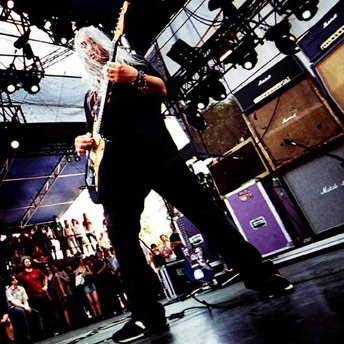
Okey dokes, so I was obsessed with Dinosaur Jr. for a great deal of my childhood/teenagehood/twenties (must I date myself?). Something about that guitar sound--Green Mind is still a terrific album. Anyhow, while I was working in publishing I got this great idea to do a book about Morrissey's fans--it really was a thinly veiled excuse to set up an interview with J Mascis, who I knew was quite the fan. Though the book never materialized, the interview did, and the resulting piece was only ever used as part of a school assignment; it was a project where I was supposed to "experiment" with journalism. This may perhaps be the first (and, frankly, last) piece of rock n' roll writing that I've ever done. It's bloody academic-y and I sound like a giant nerd. Also, when I think about this now, it does seem odd that I called one musician up to talk about someone else's music, but Mr. Mascis was kind and did humour me. Thanks to James for archiving this...5 years is a long time ago, eh?
J Mascis on Morrissey
The post-punk era - mostly seen as bereft of political ideas and motivated primarily by a desire to either sell records or make self-indulgent art - is also the era of the Smiths. Providing an interesting antidote to almost all other British music of the time, the Smiths provide an interesting response to the times. Instead of being overtly political and anti-government, there is, I feel, a tremendously individualized resistance detailed in Morrissey's lyrics. It is subtle sometimes, other times more overt, but always insisting on positioning himself on the margins - refusing to fit in and blindly accept traditional views, morals, and ideas.
Perhaps that's why hardcore punk guitar hero J Mascis of Dinosaur Jr is such a big fan. I always thought that J Mascis's covers of songs originally performed by the Smiths were somewhat out of keeping with his normal punky fare. In addition, I've been interested in how people come to the Smiths and Morrissey and why they enjoy the music and lyrics so much. A multi-faceted and constantly evolving individual, Morrissey seems to open himself up to all sorts of fans - each one believing that Morrissey speaks to them individually. As a result, his public positioning as well as his lyrics are constantly interpreted and re-interpreted. I thought it might be an idea to ask J Mascis where he stood.
EM: The release of Dinosaur on Homestead in 1985 nearly coincides with the realease of The Queen is Dead in 1986. I enjoy both of these albums, but they are obviously very different. What kind of music were you listening to back when you started performing? Were you at all interested in the Smiths at that time? What has been your acquaintance with their music?
JM: I first saw Morrissey on the Cutting Edge TV show on MTV. He seemed quite annoying, like he wanted to be punched. I wasn't inspired to pick up any of [his music] at the time. Then, a friend in college went to see the Smiths--he was a heavy anglophile. He said they were great. I nodded in disinterest. I first got interested in their music when "Girlfriend in a Coma" came out. I thought it was really funny and I liked that it was short. I had heard "How Soon is Now" and I really started liking that song. I also liked the other video that popped up at the time - "Stop Me (if you think you've heard this one before)." My interest gradually became more and more til' I realised the genius of Morrissey. I was listening to the Birthday Party, Wipers, New Order, and Dream Syndicate at the time Dino started up. When I started doing publicity for Where You Been in England I got all their albums on 10" at the Warner office. I guess they had just bought the Smiths catalogue from Geoff Travis. That's when I first heard The Queen is Dead.
EM: Writers often list Sonic Youth and Neil Young (sometimes even Led Zeppelin) as influences for Dinosaur jr . Would you say that you have been influenced by the Smiths?
JM: I'm not sure how influenced by the Smiths I have been. I don't play like Johnny Marr or sing like Morrissey, but I love them.
EM: Having recorded covers like "Just Like Heaven" and "Show Me the Way," was there any particular reason why you chose to cover "The Boy With the Thorn In His Side"?
JM: I guess I was really getting into the Smiths at the time not realising that everyone already loved them. You know you get into a band and it seems like you discover it and no one else has ever really been into it like you were. I'm playing in england and every American band does a Smiths cover as if the English will be really impressed that you know this cool English band, but they're just bored. "Oh no not another American saying 'I'm cool, I dig yer people, I get it, English right?'" I didn't realize it was boring and uncool til' later so I still had a genuine enthusiasm while playing it. Americans still love to cover the Smiths - it's just not as tiresome over here. We weren't beat over the head with Morrissey in this country. He still seems cool.
EM: What is your favourite Smiths/Morrissey song? If you were to make a mixed tape with Smiths/Morrissey songs, what songs would you put on it?
JM: It's hard to pick a favorite song - it changes. Maybe "Panic." I like "Last night I dreamt somebody loved me," "Ask," and "Some girls are bigger than others."
EM: As an American hardcore/punk/grunge/indie pop figure (sorry to categorize), your version of a Smiths song raises questions about the influence of the Smiths in the US, and their influence on other musicians. What do you think the impact of the Smiths/Morrissey has been within the states? Can you think of any unlikely bands/musicians that have been influenced by their music?
JM: People I know seemed to start liking the Smiths after they broke up. They were a little too much for people at first - you had to ease yer way into them. Like, Henry Rollins would talk about wanting to beat up Morrissey and Robert Smith. The English camp takes a little getting used to after being a testosterone filled hardcore kid. Still a lot of my friends think the Smiths are too wimpy, but those who love them really love them. I thought it was funny when Choke from Slapshot really got into the Smiths and Slapshot started covering "How Soon is Now." He was the "hard" in "hardcore" - they didn't come much harder. Suddenly it was OK in Boston for hardcore kids to love the wimpy Smiths as well as loving hockey.
EM: Morrissey's fandom decreased in the UK after the break-up of the Smiths, but he gained popularity in the US. Granted, Morrissey still enjoys international recognition (enough to be named the most famous artist without a contract by Mojo magazine) Why do you think that Morrissey has such an enduring popularity?
JM: He's extremely talented - a great singer and lyricist. Why would people stop loving him?
EM: Have you ever met Morrissey? If so, what did you think of the man? If not, do you think you might get along with him?
JM: I never met him. I would hope we would get along famously after having 5 or 6 tea times together.
[EDIT: Whoops! I guess I was wrong...I did write this. Oh, and I couldn't help myself:]
Tuesday, September 26, 2006
I am not a human being
So I interviewed Lee Perry last week. The attached video will give you a wee sense of the experience...
I now have to figure out some way of translating what many might call genius, but what seems to me to be, well, I don't even know. At the end of the interview--which was hard to end, because Perry kept telling me that he had more time to talk--I was a little speechless. For those of you that know me, it's probably hard to imagine.
Is he a genius? Of course. Is it possible to demonstrate that genius over the phone from Switzerland? Probably not. I have now, however, been made aware that Scratch is not only from the countryside of Jamaica, but he's from the Ice Age. This statement does indeed contradict the above commercial pronouncement. In addition, of course, he's also not a human being. Cue Mad Professor.
Friday, September 22, 2006
Wednesday, September 20, 2006
I've got a bag full of sleng teng and aint nothin' gonna stop me
I've just been listening to Rodigan's radio clash with Barry G from 1985. From the beginning, when Rodigan calls the Half Way Tree police station to have an officer toss a coin, determining who drops the first dub, you know it's going to be wicked. Though Rodigan starts it off well, Barry G immediately kicks it up a notch with an Echo Minott sleng teng dub. Roddy hits right back.
The man isn't called Father Rodigan for nothing.
In the above video he's playing one of his famous dubs--I'm sure Love Injection was killed dead. And though I've recently become obsessed with YouTube dance videos (see here, here, here, here, here, and here), it's Rodigan's dancing that rules.
The man isn't called Father Rodigan for nothing.
In the above video he's playing one of his famous dubs--I'm sure Love Injection was killed dead. And though I've recently become obsessed with YouTube dance videos (see here, here, here, here, here, and here), it's Rodigan's dancing that rules.
Sunday, September 17, 2006
Gotta love the Northern soul...
As promised...a couple of lovely tunes from Ms. Clark. Enjoy--thanks to Vero!
Don't You Care
Don't You Care
To much listening, not enough writing
 Because this album is too much greatness to deal with at the moment. If I can figure out the mp3 posting scenario (help me, pretty please!) maybe I'll post something fun this aft. But, my goodness, I should be writing.
Thursday, September 14, 2006
A photo taken at Dawson yesterday
 Photo from cocolinda's flickr. It's what I wish I could focus on in reference to yesterday. Thanks to all who called, concerned for my safety.
Monday, September 11, 2006
Apart from the obvious commemoration going on today...
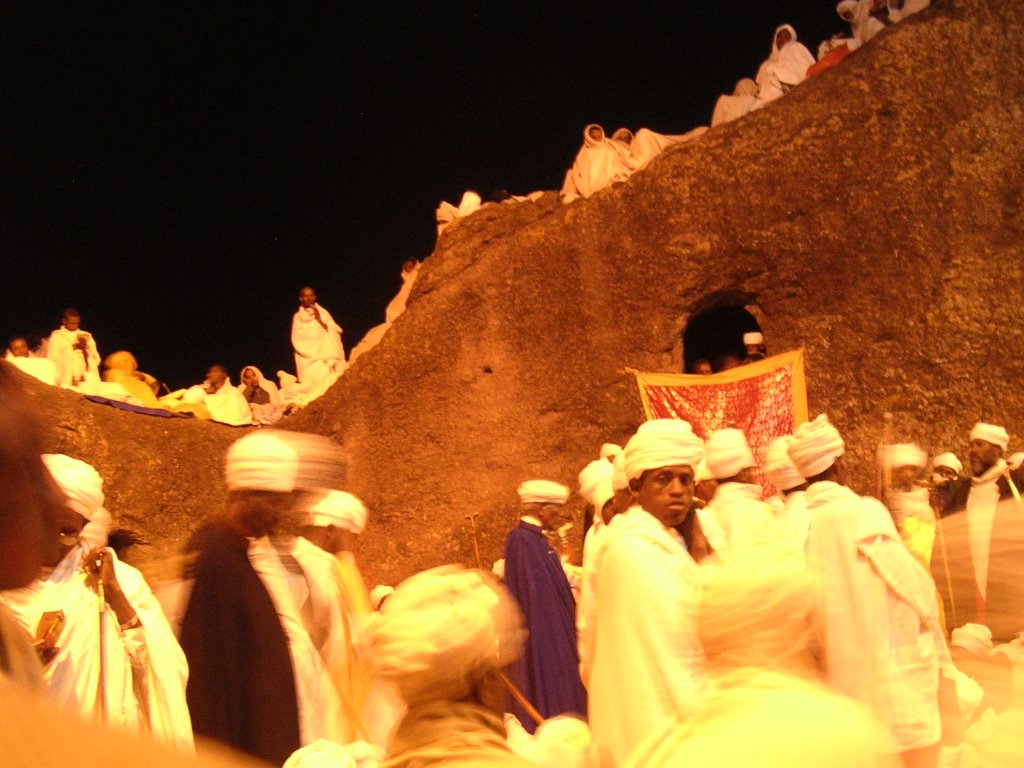
Melkem Addis Amet! Today is the beginning of 1999 in Ethiopia. In celebration, I give you one of my favourite photos of Ethiopia--it's picture of Christmas celebrations in Lalibela.
For those of you who are unfamiliar with the Ethiopian calendar, it's based on the Julian calendar, unlike our western Gregorian calendar. There are twelve months, each with 30 days, and a thirteenth month with between five and six days--depending on whether or not it's a leap year. Today marks the celebration of Ekutatash, and the first day of Meskarem. It also, however, marks the beginning of the big countdown to Y2K for Ethiopians.
Multi-billionaire Al-Amoudi, who, many would argue, might be better off spending his money on more significant projects, is installing giant countdown clocks in Ethiopia, readying the country for its entry into the next millenium. Rastafari have told me that we should pay attention to this, the "real" year 2000. Hmmm...
Hopefully next year I'll be there to see just what might happen.
Saturday, September 09, 2006

Friday, September 08, 2006

Thursday, September 07, 2006
Talking Will Holland's ear off Part 1
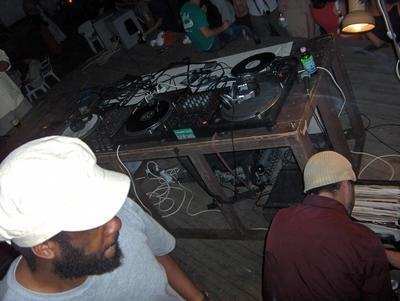 In the above photo, which, admittedly, tends to showcase the turntables more than anything, is Andy Williams at left and Will "Quantic" Holland at right. I just sorta liked the photo-thanks to cratesoul.kepeim.hu. I think I want to go to Hungary now.
Anyhow, as promised, here is the interview I did with Will (using the first name sorta takes away from my journalistic mystique, eh?) this past weekend. I'm cutting it in two because it's quite long. An extremely short version appears in the Montreal Mirror today. I haven't really edited much of this, so I sound pretty blather-y, if that's a word. I tend to get a little excited when I get to talk to people who've been to Ethiopia. I'm a dork that way. Anyhow, on with the show. If you don't know who Quantic is and what he does, you should. His music is simply terrific, and he seems a darned fine fellow to boot.
EM: I see you as taking the concept of crate digging to a whole other level. What do you look for?
Q: I think that the basic form of crate digging where it’s basically looking for breaks, drum breaks to loop up or to sample and things, and then I think that once you do that for a whole [laughs] you just get in to music more. And you get into it a little more deeply; you get in to all kinds of music, regardless as to whether it has a drum break in it or whether it’s a funky record or not. So myself, and probably Miles [Claret, of Soundway records] also, are both looking for quite eccentric records, and definitely dance records. Something that you can play out in a club and it will go down well and be played up to good effect, but also something a little eccentric so it could be a calypso record, a salsa record, an afrobeat record, but it has to have something interesting about it.
EM: You travel around a lot. It seems like you want to go to the source of the music you like—take, for instance, Ethiopia’s Mulatu Astetke.
Q: Well I guess—I’m actually sitting here with Miles now—and I guess the thing is, all of these things start off in record room, it a kitchen, listening to a record, and going “Oh my God! This is amazing. How was this made? Who made it? Where do they come from?” Miles had of those moments a few years back and said, right, I’m going to go to Ethiopia and he bought the ticket to Ethiopia. And we were just sitting around one night and [Miles] told me he’d gone pretty briefly, but he’d found some nice records. We just decided to go again, with the premise of trying to track down Mulatu for an interview. So we interviewed him for Wax Poetics. And also we wanted to do a potential sounding out of whether we could do some recording over there. Which actually, we haven’t done yet. It’s all kind of gone a little bit wrong. I mean, it’s gone well for Mulatu, because he’s got this “Broken Cloud” track and he’s got a lot of interest through that. But it’s becoming increasingly hard to pin him down, to set dates, because he’s a very busy man. But as far as getting out there, it’s just the case of buying a ticket and just kind of winging it, really. [laughs] Actually, Mulatu really took us under his wing.
EM: Ethiopians tend to be nice like that!
Q: Yeah. You know, all these places, some are heavy places to go to, but people are really friendly. I think it’s like anything—when somebody’s taken an interest in your culture, unless you’re robbing or something, but this is something that we are promoting and trying to keep the knowledge of this music alive. A lot of these forms of music are dying out. A lot of people don’t want to being learning to play drums in Africa, they want to use a drum machine.
EM: Vincent Kenis, who’s worked with Congolese musicians, most famously, Konono No. 1, he said that in Kinshasa, none of the young people really want to listen to the traditional music. In Ethiopia, it’s the same, everyone wants what’s new—the latest Amharic pop music. When I’ve asked kids about Mulatu Astake, they’ll say, “Oh, my parents like him, we like Teddy Afro.” In Ghana as well, there are not a lot of people listening to the tracks found on Soundway’s compilations. It’s like you’re resurrecting the past—do you feel that you should focus more on contemporary tunes?
Q: For me, I’m interested in real music and music played in the room with an atmosphere to it. Just because I like Puerto Rican Rhumba records from the 60s doesn’t mean I have to like reggaeton. For me, the two things are so far removed. [Music] just becomes a generic culture that doesn’t have any roots in [a cultures] own heritage. With reggaeton, a lot of the time it is a just a dancehall riddim. There are interesting things, modern Caribbean records; I have found some nice modern Ethiopian stuff, but only a few. To be honest, I really like drummers and I really like live music. And I like things nasty, kind of messed up, in a way that it gives it character. And I think what you’ve got to remember with these older recordings is that they were made in really unique times.
EM: Yes.
Q: You had army bands and military bands, police bands—especially in Ethiopia. All these bands were part of clubs and I don’t know whether you’d get a recording now from twenty Nigerian policemen, playing a funk track or an afrobeat track or a high life track. I don’t think that’s happening any more. I think it’s about getting kinds who are into music aware of that olds stuff and how they can add that into their music and not do some kind of “Mr American” style thing, trying to be a rap star. Instead, be more in keeping with the music that they’ve come from.
EM: In Ethiopia, even though kids like modern stuff, there is still quite an appetite for not Mulatu, but very traditional Ethiopian music. Played on the masinko and krar, in a pentatonic mode that’s really different than what Westerners are used to listening to.
Q: Yeah, I like that stuff! [laughs] I remember I went with Miles and Mulatu to this restaurant in Addis and they had the traditional players playing that stuff on krar and we had to get up and do this dance, you know, with the shoulders.
EM: Of course!
Q: And Miles was thinking, god, we came to find Mulatu and here we are shaking our shoulders to the krar. I think though, it’s interesting and it’s all part of the music I’m interested in and so is Miles as well, is that point where all these forms of folk music were becoming modernized. Maybe they were trying to be a little more commercial, trying to be a little bit more turned into a product.
EM: It’s as if you’re looking for links. With Mulatu, you do hear the minor strains so common to Ethiopian music, mixed with other influences. With early calypso, you hear the traditional chanting. It’s almost like being a musical archeologist.
Q: Definitely. I think it’s just looking to see what spices were turned into pop a long the way. With Mulatu, you can hear Chinese music in there and you can hear all the Puerto Rican rhythms that he picked up in New York. And you can hear the fact that he was in London playing with jazz guys. I love going on these trips because you hear just the strangest music.
Part 2 to come...
Subscribe to:
Posts (Atom)