Sunday, April 08, 2007

Review that wasn't printed, yet is relevant at the mo

Ghislain Poirier
Bounce le Remix, Vol 2
(Rebondir)
What is there to say about Ghislain Poirier except that he's a gem and, thank goodness, he's ours. Montrealers who religiously flock to see the scruffy Mr. Bounce le Gros know what to expect, and the man never dissapoints. This remix record is hardly an exception--no matter what Ghislain seems to touch, it comes out ridiculously, painfully danceable, and he seems to be having a ridiculously fun time doing it. Sparse, weird, and, dare I say, smart booty shakers abound here, and the list is not without a few surprises. It's an energy that's so infectious that allows for a beyond kicking-it-up a notch energetic remix of Bunji Garlin to be the type of thing that I leave on friend's answering machines.
9/10
Erin MacLeod

Tuesday, March 27, 2007

Skating in the pre-Tonya Harding era

In a previous life, I used to figure skate. My idols were Isabelle and Paul Duchesnay, a brother/sister dance team from Aylmer, Quebec that skated for France after being criticised for being too weird by the Canadian figure skating establishment.

In 1990, they performed an incredible program entitled "Missing", choreographed by Christopher Dean (of Torvill and Dean fame), a piece calling attention to the dissapeared of Argentina. In 1991, their free dance was a sequel. When I found this on the gold mine that is YouTube this weekend, the shivers I experienced while watching it were the very same as when I saw the program the first time, over 16 years ago.

If there was ever an argument for the artistic potential of figure skating, this is it. There is nothing particularly spectacular about any element of the program, but it's just amazing overall. Now that there's all sorts of new rules governing ice dance, folks like the Duschesnays would never be able to perform something like this.

I 've always said that figure skating would be so much better if it weren't a sport. There's a whole lot of artistic potential that is lost in lieu of the conventions of competition. There's just no room for the Gary Beacoms of the world. Sure, Beacom is a rather eccentric fellow who, among other things, was jailed for refusing to pay taxes and insists on keeping his money in gold coins rather than relying on banks. He also doesn't believe in stop signs and speeding limits. But man oh man, he's incredible. His understanding of the physics of skating is apparent from his programs. No jumps, no spins, just the use of his edges...it clues you in to why it's called "figure skating."

When I used to skate we had to do what was called "patch" session. Each skater got a patch of clean ice to use to do what is called compulsory figures. You'd basically draw various shapes and loops on the ice, making sure to balance your weight just so, in order to make sure that the turns and loops you drew were precise. The jumps that are so popular are simply these "figures" done in the air. A loop jump, for instance, employs the same body positioning as a loop drawn on the ice. In fact, compulsory figures were worth 60% of the marks in figure skating for quite some time. Sure, figures aren't particularly fun to watch on TV, but they are incredibly hard to do. In what I think was a big mistake (though probably good for business), figures were completely eliminated from competition in 1990--and this meant that new skaters stopped practicing them altogether.

What makes Gary Beacom amazing is that he is able to demonstrate just why it's a shame that figures are no more. He's a master of the discipline...I remember when I first saw him skate. I couldn't believe it. See what you think...

Tuesday, March 20, 2007

The City that MOTO-vates Canada

How fitting that the day I discover the craziness that is Facebook and end up reliving my teenage years in the Shwa is also Stephen Colbert Day and Mr. Darrin Rows, the man who used to be the boy who prevented me from entering Madame Hoef's French class, is opening the festivities.

I have to say though, I am rather distressed to find out that they've dispensed with the old motto for "Prepare to Be Amazed". Amazed by what, pray tell? The Oshawa Centre? The Genosh? The Automotive Museum? Oshawa never even had Wheelies or Stairways. If they did, that'd be another story.

Thursday, March 15, 2007

"It was planned that way, carefully worked out. These people are scientists, ladies and gentlemen."

In the wake of a computer disaster, Red X, the CD king, is keeping my hope alive. His 30th mixed CD, A Different World, simply rules. Sure, it'd be nice if he left some fo the tunes for more than 45 seconds, but it's a pretty wicked mix. And man, Red X's anthem on his myspace--wicked.

If you too are stressed out, listen to to "Rationalize" by Brian and Tony Gold: "No matter what the tribulations in life, just hold tight". Gotta live the Di Ting riddim.

Saturday, March 10, 2007

A man after my own heart

In a moment of insanity I did a google search for "I hate comprehensive exams." This is what I found.
I also found a picture of someone's shelf, full of books for their comps. Maybe I should do a photo shoot of my stacks.

Also: note the sun outside the window in the photo. I saw this and realized that there is a bright side to all this. At least it's not June.

Friday, March 02, 2007

Purty as a picture

This piece looks pretty, dontcha think? I really think the picture is quite beautiful. Folks should really come out to see her at the Goods this weekend. I do have an unedited version if anyone's interested. Voice does, most certainly, have plenty to say and it was tough as all get out to cut anything...thanks to Dave for the help--I know you were wicked busy!

Wednesday, February 28, 2007

Radio Gaga

Thanks to Robert for commenting on the last post, I spent some time learning about Gaga in addition to Rara. I'm just a beginner here, so thanks!

Anyhow, Michele Wucker writes that "when Haitian migrant cane cutters transplanted the rara to the Dominican Republic, the Spanish attempt to pronounce the French 'r' turned the word into gaga, an unintentional but appropriate play on the word's other meaning, 'crazy.'" There's also Gaga that goes on in NYC.

For an example, check this video of Grupo Kalunga Nèg Mawon by Dennis Flores. These folks aim to both preserve an demonstrate the collective identity/ies in what is now Haiti and the Dominican republic. They also sound wicked.

Sunday, February 25, 2007

Dancing in the Streets

The other day I was talking on the phone with Symon Warwick, a.k.a. A Man Called Warwick. I was supposed to be interviewing him, which happened, but then we just went off in all directions talking about music. He's got an infectious excitement about music that makes me want to run out and listen to all sorts of new stuff. We got on to the topic of Rara, a type of Haitian processional music that's made with drums, horns called vaksin, cymbals, and tons of energy.

As Elizabeth McAlister, author of Rara! Vodou, Power and Performance in Haiti and its Diaspora, writes, Rara "is at once a season, a festival, a genre of music, a religious ritual, a form of dance, and sometimes a technique of political protest." Raras move people--both literally and figuratively. Dancing through the streets and countryside of Haiti, leading up to Easter, raras have made it to New York city, moving thousands of people through Prospect Park in Brooklyn. Rara is able to encapsulate the movement of a diaspora in a fitting cultural celebration. Hearing the kids saying "when we grow up, we're going to take over and continue this" is a demonstation of how Rara not only moves through the park, but it moves through generations. As someone who is interested in what music can actually do, Rara clearly is fascinating to me.

I'm hoping that the documentary The Other Side of the Water will makes its way to Canada soon, because I simply can't wait. The clip on the site isn't enough. Thankfully, McAlister has a treasure trove of rara photos and video on her website companion to her book.

Dancing in the street simply doesn't happen enough here in Montreal. In January, in Ethiopia, I was lucky enough to time my visit so I could be part of the Timkat (epiphany) celebrations. Each Ethiopian Orthodox church has a replica of the Ark of the Covenant. On Timkat, these Arks travel to large fields--in Addis the field is called Jah Meda (no relationship to the Jah of which Rastafari speak)--where they stay until the ceremonial sprikling of Holy water over the gathered crowds. After, the Arks are carried back to their respective churches, accompanied by dancing and drumming youth groups. Check around the 3:45 mark of the film below to see one of the dancing processionals. Frankly, the whole short is pretty great--it's a demo reel for a longer film about Ethiopian traditional music. I've searched around for more info about the film, but can't seem to find any...looks like it'll be pretty interesting.
In related street dancing news, Dave sent me the following video of what happens on Saturday afternoons in his neighbourhood. Clearly, Heringey is the place to be. I wanna know more about this, and I want to master the dance moves featured in the last few seconds of the video.

Friday, February 23, 2007

Why I wish I was in Germany tonight

The legendary King Addies performs alongside Shashamane Sound (Kenya represent!), Sentinel and Supersonic. Killer. Seriously. As a result of writing my public declaration of love for the soundclash, I 've been hankering for a good dance...

King Addies is a sound that would be wicked to see. Someone wrote me about them after the aforementioned piece. Addies ran Brooklyn in the 90s and provided a training ground for the now legendary Tony Matterhorn. The famed JA vs USA clash against mighty Killamanjaro saw Jaro come out on top, but Addies gained quite a bit of respect. As Fyah Mikes reports (here's some credit for you, you silly), it's really Addies' Toni Braxton dub that has put them over the top in many a clash.

Though Danny Dread is the original Addies selector, in the later 90s, Tony Matterhorn, who, with Babyface, had become the voice of Addies, left to form his own, now terrifically successful, sound.

Coming back in 2006, Addies fought valiantly against Blunt Posse in a November clash and, though arguably winning the most rounds, flopped in a final, tune-fi-tune round.

I'm interested in the fact that Danny Dread is selecting in Deutcheland. I'd heard that King Bo has been working with Addies--lots of complaints about him not knowing the dub box, just being a good voice, etc. I can't say, but I would like to be in the position to judge. Maybe Addies should make their way to Mtl soon. I think I might be dreaming in technicolour with that statement.

Anyhow, to those who are lucky enough to be in Stuttgart tonight--I am jealous!

Classic Addies: UK World Cup Clash 1994. Do it inna cowboy style!

Tuesday, February 20, 2007

That's just what I'm looking for!

I have to begin writing comprehensive exams any moment now. Given my history with writing and stress, wish me luck! Hopefully I won't be turning to what Homer Simpson calls "the cause of, and solution to, all life's problems..." Then again, if I do, perhaps I should stick to Dashen!

Friday, February 16, 2007

Ich bin Canaderin, Canadawi gneng

When it's flipping freezing outside, it's easy to want to get the hell out of this god forsaken country. My reaction, instead, seems to be simply glorying in all things Canadian. In the darkest depths of February, pretty much every year, I go through a short (yet intense) period of listening to Tragically Hip, Grapes of Wrath, Lava Hay, Gordon Lightfoot, and other Canuck luminaries. This year, with the advent of Youtube, I can satisfy my desire for Canadiana by watching the snow-covered videos for "Bobcaygeon" and "Lovers in a Dangerous Time" (the Barenaked Ladies version, of course).

I also tend to watch A LOT of CBC during this time. So last night, whilst watching Strombo interview British celebrities he clearly knew nothing about (not that this was a bad thing--it was kind of great), Aurora and I got into a oh-so-Canadian oriented discussion about former MuchMusic VJs. Wikipedia being the wonderous tool that it is, we began with the Hour's noble host, and continued through Steve Anthony, Kim Clark Champniss (did you know he was the manager of Images in Vogue?), Simon Evans (who seems to have fallen off the face of the planet), Michael Williams, Ziggy Lorenc, and then, oh yes, Tony Young, a.k.a. Master T.

Get this: buddy has, as Tash has hilariously written, Extendamix-ed his career by being a part of the new VH-1 show I Love New York-a spin-off from Flavor Flav's Flavor of Love. He's ditched Roxie and alter egos such as T-McGee, and is now referring to himself as the 32-year-old hottie "T.Weed." If you don't believe me, check www.myspace.com/tweedtv

This would have been a wonderful addition to the autobiography released by the publishing company I used to work for in a prior life. Oh yes, not would you get to read about the pleather pants Master T wore to an interview with Sade or Dr. Dre's bathroom proclivities, but you would also get such gems as are found on his myspace: "One man pretends to be rich yet has nothing; another pretends to be poor, yet has great wealth. A man's riches may ransom his life, but a poor man hears no threat." What wisdom!

Now, of course, there is a chance that this is all a giant mistake, but until I discover otherwise, I am going to continue chuckling every time I think about this! Teehee!

Sunday, February 11, 2007

Putting on the Red Light

Okay, so I just finished watching the Police perform their comeback on the Grammys. Yes, I'm still attracted to Sting, but damn, I wish they'd of played "Every Little Thing She Does is Magic."

Tuesday, February 06, 2007

I'm behind the times--or really ahead, depends on what you're talking about

Ok, I've decided that I'm going to eat crow and admit that the self-titled record by the annoyingly anonymous "Burial" is actually spectacular--contrary to statements made to one Dave Stelfox and another tvv. I still think it sounds dated, that I like stuff with lyrics better (oh the humanity!), and that the third track, "Spaceape," is utter trash. Thing is, I can't stop listening to the damned thing.

Sure, people who are less fraudulant music journalists than I have been writing stuff like the following for ages (the record was the Wire's best of 2006):
"Far from speaking of final resting places, the overriding vibe is one of homelessness and rootlessness, and the nagging feeling that something important has been mislaid."

"This album actually comes complete with a concept (it's a sound-portrait of a near-future south London submerged under water, New Orleans-style) while the most compelling readings of its theme hear it as a requiem for the lost dreams of rave culture. But the non-specific sadness that shimmers inside this music ultimately transcends attempts to pin it to a place, period, or population."

The record is, yes, haunting and "shimmery", but I don't know from North, South, East, or West London, be it underwater or above ground. Nor, frankly, was I ever involved in rave to have the music thereby elicit a sense of mournful loss. As I mention, the music is very firmly dated, in my mind, but this isn't really a bad thing, unlike when I had to review the anniversary edition of Endtroducing and found it really tough to get myself and my ears back into the time of its release. It feels very pre-millenial (perhaps as a result of a track like "Prayer," which, to me, is a complete reiteration of Massive Attack's "Teardrop," a.k.a. the theme song to House), and, strangely, provided an excellent soundtrack to my field note writing in Ethiopia this January. Perhaps this speaks of it's "transcendental" nature, but I think that it is music that is less sad than bored, perhaps more non-specific than gloomy; music that speaks of ennui. I guess that's what might have created my original resistance, but now seems to make some sense. Then again, the whole keeping-the-artist's-identity secret is a little silly. It seems more of a response to boredom or an inspired attempt at pr. Whatever it is, it's quite emblematic, to me of the UK. More on that, perhaps, in another post, if I decide to get testy.

Recently, though, as much as it wants to be headphone music, I do, shame on me, increasingly want to dance to this stuff. This means that she who tells me I shouldn't be so down on dubstep is prolly right.

In news that I'm not behind the times, yet instead might perhaps be ahead of the game, do read what I think is a hilarious post by Houston hip hop impressario Matt Sonzala. I don't know this guy, but he's ridiculously funny. In the post that follows, he's talking about what I believe might be the most Oshawa of events (Oshawa being my wonderful southern-Ontarian hometown), save for it being in New York, Brooklyn specifically. His post CMJ "Sabbath in the Park" party, Prospect Park specifically, is pretty much classic, early 90s bush party action, without the bush. Turns out the folks involved got arrested and ticketed for their 'shwa action, and then had to return recently for court appearances that would have really been non-events, had Matt not been there. The post-"Sabbath in the Court" is, of course, one of the best parties ever and for making all this possible, Mr. Sonzala, I salute you!

We Fought the Law and Won, cuz like the Geto Boys, We Can't Be Stopped

Monday, January 29, 2007

Buna and Big Business

$1.10: Amount per pound of coffee that growers receive after deducting costs

$160: Amount that retailers can make on a pound of coffee


Those who know me know that I'm a big fan of Stephanie Black's Life and Debt. It's a stunning film that addresses trade issues and their impact on Jamaica. The brilliance of the film is that it provides a direct connection between the real people who have been impacted so proundly negatively by world trade policy and those who come to vacation and experience overwhelming beauty of Jamaica. Utilizing a narrative adapted by Jamaica Kincaid, from her pointed and poignant essay on tourism in Antigua, A Small Place, the film attempts to break down the barrier between the resort compound and the reality many lives lived beyond those walls.

If globalization is supposedly about linking countries together in some economic matrix of sorts, Life and Debt presents an analysis of just how and for whom these linked relationships work. It's a moving piece of film making that forces the view to recognize his or her place in the matrix and encouraging awareness as a means to work towards change. Also, it's got a wicked soundtrack.

Much to my absolute and total delight, a new movie looks to provide an analysis of these very same relationships. In the director's statement for Black Gold, a film about coffee growers in Ethiopia, Starbucks, and supposed fair trade policies, the filmmakers write the following: "Our hope was to make a film that forced us, as western consumers, to question some of our basic assumptions about our consumer lifestyle and its interaction with the rest of the world." Now that's what I'm talking about.

It's all about making connections, and Black Gold looks like it'll do this. Now bring the film to Montreal already. Until that happens, watch the trailer.


Notes:

Not surprisingly, Starbucks has issued statements addressing some of the points raised in the film, and they've done this using the warm-and-fuzzy tool that is youtube.

Guardian Article on Black Gold and the response

Sunday, January 28, 2007

I'm a dirty foreigner

When I was in Ethiopia over the past month, I kept a little journal, lovingly titled "complaining and field notes." There was so much to say that the journal rapidly stopped being so little. Anyhow, to keep from complaining about how sick I am right at this very moment, and how I wish I felt like I know I did in the attached photo (taken at Entoto in Addis, fyi), I'll provide a wee excerpt from my journal. It's not the most exciting...All the names have been changed, just because I'm that ethical. :)

By this point, it was 1pm and Tegistu thankfully gave me a ring. I met up with him on “the new road” and we went to Tele Club for lunch. I’ve been there with him for lunch before. As usual, the food is really good but the washing/washroom facilities are disgusting. I had a discussion with him about this and he said that it’s not in the culture to really care about that type of thing—though he did insist that in his new house, he is going to keep the shinte-bete clean!

Tegistu and I did a bit of a language exchange and then went to see Hailemariam to repay him for monies provided to the municipal government as reagrds the establishment of the school we're planning to build. This was cool because I also got to take a short trip to see the land for the school. It looks pretty good and is really close to a residential area so that kids won’t have to walk that far to get to the school. After joking around with some locals using my extremely limited Amharic, Tegistu and I went to the town bazaar. It was really weird when I got there because all sorts of people--and by this I mean hundreds--were waiting to get in and me, the white girl, drove straight in on the back of Tegistu's motorcycle. He told the guards that I was an honoured guest--"a friend to the community," if you trust my translation. I thought he was joking around, as he normally does.

The bazaar was made up of a bunch of business tents—like a chamber of commerce fair. You could buy pretty much everything: tvs, soap, shoes, raw beef, sheep, refridgerators, and beer. My favourite was the advertisement for Dashen beer: "Hangover Free!" As we walked around, the deputy mayor, Ato Wubatu, whom I'd met in previous municipal government meetings, walked up to me and said hello. I introduced Tegistu, but Ato Wubato dragged me over to see this large group of men in suits and asked me to sit down one of what appeared to be gilded thrones. All I could think of was how dirty--koshasha--my feet were and how my hair looked ridiculous. At this point, who sits down next to me but the Mayor, the Zonal Chair, and the public relations head for the region. I sat in the fancy chair for a while, was introduced to a whole lot more people as "the foreigner who is building a school in our town," which I tried to consistently correct. It's not just me, I said! It's Schools for Humanity!

I turned around to look for Tegistu—he'd been relegated to the back. “Na!” I called, ushering him over. He was laughing at how uncomfortable I looked. "See," he chuckled, "told you you were an honoured guest." I asked if we could go and get my filthy feet washed before I had to teach that evening. We then got up, walked around a little more, and then left, but not before the Zonal chair could say “see you at the office.” I suppose this means I must visit him tomorrow.

I washed my feet at Tegistu's house. He laughed at my inability to wash using a pitcher and basin without making a giant mess. I should probably practice this skill--it might make me a little better at it. As it stands, if I don’t have a shower or a bathtub, I’m a little lost. I asked if I'd looked stupid in front of the government officials. Tegistu's response: "You've looked better, especially your hair. But you're a forenge (foreigner). You all dress weird and don't seem to care."

The classes went well, considering there are about 100 students in each one (some sitting on other student's laps, the ground, anywhere really) more coordinating conjunctions and independent clauses. I’d really like to start at the beginning with the students and see if I could make any difference with them. It’s hard to tell after two classes, but the fact that they all remembered my name demonstrates that they’d probably remember a whole lot more if I was there for longer.

Tegistu and I were planning on going back to the bazaar, but it was closed. We tried the Fasil hotel for dinner, but it was also closed. I asked Tegistu if he wanted to come back to my hotel for food. "It's okay," he replied, yet I knew he meant "Yes." I tried to explain the difference between "it's okay" and "okay," one means no, the other means yes. In the middle of my explanation, we both agreed that English is really annoying. Regardless, we ended up back at my hotel for tibs. Pretty good food and good conversation, nonetheless. I ended up explaining chicken with stuffing, pork roast, Yorkshire puddings, bacon, and hotdogs to Tegistu. He’d never heard of them before. His final comment was hilarious: "I think that's the kind of food habesha (Ethiopian) ladies eat when they go to America. They all come back wofram." You can probably guess what he means.

Friday, January 26, 2007

I'm back


Well, sorta. I'm in Hackney at the moment, but will be back in Montreal tomorrow. Can't wait. I'll write a longer post then. Until such time, however, here's some photos of where I was yesterday.

Friday, December 29, 2006

Hackneyed

I'm in Hackney and it's raining. Shocking. There goes my plan to take a jog this morning. Anyhow, since I'm sitting here lazily, I thought I'd post some pictures of what some people (or perhaps one person who'd like it to catch on) refer to as "God's own borough."


P.S. Sorry for no Christmas blogging, but it's tough to blog from the beautiful technological abyss (i.e. no internet) that is Bourget, Ontario. Hope everyone is having a lovely holiday thus far. I miss you all!

Sunday, December 10, 2006

Cocktails, Cocktails and Countdowns

Booze
Last Thursday I hosted a no beer/no wine party--seulement les cockatails! I also insisted (because I like to makes demands of my friends) on cocktail attire. For photos check here. I had a few too many Woohoos, Ameretto Sours, Coke and Wines (thanks Pierre), Alize and Juices, Lemon Jacks, and, I think, Jedi Mind Tricks. After a while it was really tough to tell. Clearly I was intoxicated, else I wouldn't have allowed Ms. Vero to do this. Anyhow, it was a whole lot of fun, so thanks to all who showed up and gave me an opportunity to wear my prom dress again.

The next day I had to write my top ten of the year--no real surprises, except maybe that I'm totally crazy for Keak da Sneak. How great an album is Kunta Kinte? I was at the Mighty Crown dance on Friday (unfortunately not as well attended as one might have wished, but still fun) and they palyed a number of versions of "Ridin' Dirty." Not bad, but when I am going to hear dancehall voicings of hyphy tunes? How great would that be? Seriously.

Imagine what Sizzla or Capleton could do with this:

Saturday, November 25, 2006

It's Pumpkinninny!

I've recently become re-obssessed with David Cross and Bob Odenkirk's brilliant mid-nineties masterpiece, Mr. Show. I probably never lost my love for the program, but I've just recently been annoying (or, I hope) entertaining my pals (and my family) by sending sketches culled from, of course, YouTube. Thing is, whilst looking around for more information about the immortal Josh Fenderman (and the lyrics for the amazing Honesty in Motion tune), I found what I believe to be the inspiration for "the young boy who made faces like he couldn't believe what he'd just said." Behold, Corey Feldman performing "Honesty" on no other show but Electric Circus--MuchMusic's amazing flagship dance music show that allowed, in the early 90s, anyone--as long as they showed up at the right time--to be a ass-shaking extra. The performance is mind blowing. I love the suit, and the dance moves are pure Fenderman. It would only have been better if I could've found a video featuring the other Corey--who, incidentally, I've met on more than one occasion--but that's a story for another time.

Josh Fenderman


Corey Feldman

Tuesday, November 21, 2006

Equally viable at both speeds...

I remember, ages ago, my brother and I were being silly and listening to records. He put on this old calypso single called "Show Them" by Ed Watson and the Brass Circle. Switching the speed from 33 to 45, my brother announced that the record was "equally viable" whether fast or slow. Now, as per the usual, I'm a little behind the times and need folks to tell me what's cool, so I didn't really get up on the whole screwed and chopped movement 'til recently. Thing is, a few of DJ Screw's mix tapes and OG Ron C's Fuck Action Vol. 40 later (thanks Dave), I'm a little obsessed. I send mp3s to people, I blather on about it to my colleagues at school, and, of course, force my long-suffering friends to listen to track after track. Then again, they're probably happy that I'm not insisting that they watch/listen to yet another dancehall tune.

With the memory of "Show Them" in my mind, I'll show y'all how screwed and chopped moves beyond the creation of music enjoyable at different speeds, but it simply gives a whole new identity to the song. Check the full effect by listening/watching (how I love that videos are screwed and chopped too--it makes some of the dance moves look wicked) both versions of Lil Keke's spectacular "Southside"--not just equally viable slow, but simply terrific. The best thing ever--at least for today.

Monday, November 13, 2006

Just right there in front of your eyes...

Okay, so I'm a little late on this one, but I'm fully addicted to the song "Changes" by Tahiti 80. I loved Puzzle back in 1999, but this new album is pretty fun. The most fun, however, is to be found in "Changes." I said to someone this morning that it makes me feel like going out and getting a Diet Coke and some gummi worms. I think tha's a very very good thing.

Tuesday, November 07, 2006

Endemen wallachiu!

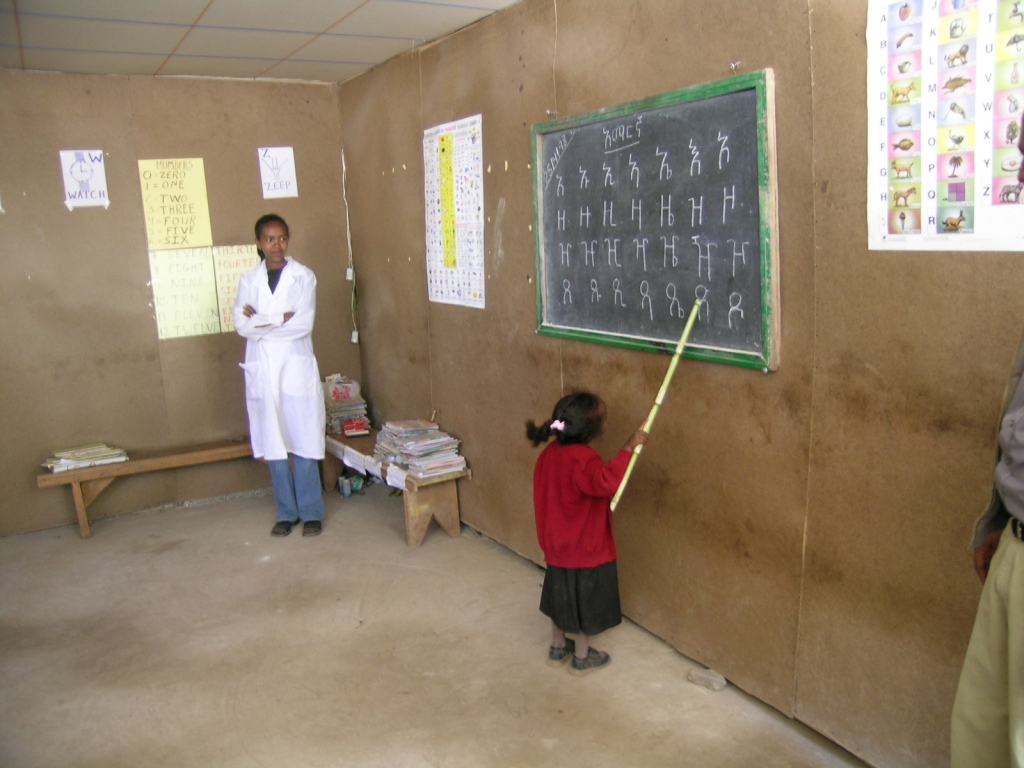
I'm learning Amharic for my research in Ethiopia. There are over 80 languages spoken in Ethiopia, but Amharic, though a minority language, is the "lingua franca"--as they say. The language is semetic, menaing it is in the same language grouping as Hebrew and Arabic, though it is read from left to right. In the above picture you can see the language. Each letter represents a consonant and vowel. For example, the little girl is pointing at "zhe".

My Amharic tutor is pretty lovely and she always tells me I have great hair(Tsugure betam conjo nwo) even when I think it looks like crap. For this I am eternally grateful. I also get to learn fun things like how to say "I hate monkeys!" T'ot'a alwudem! or "I like beer" Bira ewudallho. I wish I knew someone else who was learning this language, but alas, I haven't found anyone.

Anyhow, maybe if I provide a list of useful Amharic words I might lure someone...or at least help you out if you ever want to travel to Ethiopia someday--which, incidentally, is something everyone should try to do, if they have the means. It's an amazing country. I've written these out phonetically (the way I think they sound--I hope it makes sense to you!). The capital letters indicate stress:

TEH-na yost AH-len: hello!
tah-DIH-yas: hi!
chow: bye!
in-deh-min-AH-leh: how are you? (when speaking to a man)
in-deh-min-AH-lesh: how are you? (when speaking to a woman)
deh-NEH-neng: I am fine.
HA-beh-sha: Ethiopian
fuh-REN-je: Foreigner (white person).
YEH-kir-tah: excuse me
EK-ah-bah-LAH-lo: you're welcome
EH-shi: ok (very, very useful word!)
ay: no
ow: yes (also pronounced as a sharp intake of breath--it sounds a little weird at first)
BEH-te: house
GOH-roh-BEH-te: neighbour
tsai: sun
ZAH-nab: rain
chack-LAH: brick, chacklawuch: bricks
KO-sha-sha: dirty
tsra: work
tan-KAH-rah: strong
TOH-low TOH-low: faster!
tat-ANG-kak: be careful!
ah-BAK-ah: please (to a man)
ah-BAK-esh: please (to a woman)
AH-meh-sah-gen-AH-lu: thank-you
san-YO: Monday
MAK-san-YO: Tuesday
eh-RUBE: Wednesday
ah-MUS: Thursday
ahr-BE: Friday
gah-DAH-may: Saturday
eh-HUD: Sunday
an: 1
ou-LETTE: 2
sost: 3
ar-RAT: 4
ah-MIST: 5
seh-DIST: 6
sah-BAHT: 7
sih-MENT: 8
zeh-TANG: 9
ah-SARH: 10
gwa-DENG-yah: friend

Sunday, November 05, 2006

Things I wish I could remember...

The occasion of Vero's imminent trip to Paris has inspired me to think back to the time I worked as an English teacher in Paris. The photo is of Rue St. Andre des Arts. I lived about 15 seconds away from what the picture displays. At the time, the lovely space invader had yet to, ahem, invade.

Thing is, I realize that there are a number of things I can't remember about my time in Paris. Google is hopeless when you're trying to find out about "that language school that would serve English folks copious amounts of alcohol and take them out for 2 hour long free lunches of Sushi or French cuisine as long as they spoke English to executives who were looking to jumpstart their language acquisition." A girl named Mariah, who worked in film and had a lovely party one night at her apartment right near the Arc de Triomphe , was the organizer of these wonderful lunch affairs. I found a postcard from her whilst cleaning this evening...wonder what she's up to. I also wonder what Mr. Maurice, who at the time was the acting sous-prefet of Paris as well as being one of my students, is doing these days. The man had the nicest office I've ever seen in my life. I got to help him with English terms and concepts that would be helpful at cocktail parties. In exchange, he'd translate the jokes in Le Canard Enchaine for me.

Fun fun fun--but not as fun as the day I decided to bow down to every craving I had for pastry. I think I had about 12 patisserie treats over a 24-hour period. Then again, what started out as the best idea in the world, ended in a fit of indigestion that wasn't equalled until a particularly bad day in Ethiopia, six years later.

I don't normally get so nostalgic, so, if you've indeed read this, thanks for obliging me...

Wednesday, November 01, 2006

Nowadays, people too deep

Thuderheist is fun fun fun. I got a big kick out of them a coupla weeks ago--though I did feel a little ancient, knowing that Graham isn't exactly a spring chicken makes me realize that it's all right. As it should be.

Given that I've been spending the last week listening almost solely to Mac Dre, it seems that I'm leaning towards an attitude that I need a little less seriousness in my life and a little more dancing. It'll help me deal with the fact that I can't take any more photos like the lovely one of Isis you see here, because I left my camera in a cab after the Omar show on Friday night. If someone finds photos of me looking rather drunk (but with great hair) alongside Omar, please direct me to them.

In general, jumping up and down is a reaction to music that I like to see. Thuderheist seems to have the ability to encourage this kind of behaviour, and for that, I say go listen to Graham and Isis now.

Thursday, October 26, 2006

Oh and yeah, I'm a little tickled about this...

My YouTube obsession has a public forum.

Holding the Faith

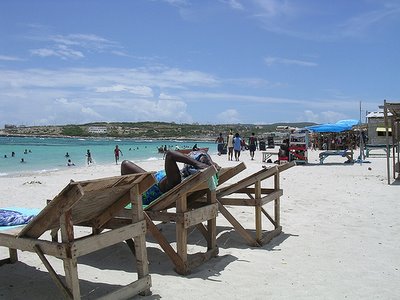
The weather around these parts has been gosh-darned awful. I always find that in Montreal, when it's getting cold, it's hard to imagine that it will ever be warm again. Then, when it's blistering hot, it's near impossible to believe that piles of snow fall on this city every year. In order to keep faith in my Canadian ability to endure seasonal change and to keep myself from falling into seasonal depression, I've taken to thinking about Portmore, Jamaica. Portmore, right next to Kingston, is home to Hellshire Beach, the whitest sand and bluest water I've ever seen. Granted, I don't have much experience with beaches, but, in my mind, it's pretty wonderful. I also wouldn't mind having a freshly cooked fish with bammy and Red Stripe right about now as well.

Portmore is also home to some of the best talent in Jamaica--and this includes Warrior King. I interviewed him last fall, when the weather was equally rainy, chilly, and just generally bad. He cheered me up...maybe it'll work for you.

In 2001, a young man took Jamaica by storm with a song called “Virtuous Woman”. Born Mark Dyer in 1979, the deeply religious artist and trained engineer who calls himself Warrior King continued to crank out niceness with tunes like “Power to Chant” and the spiritual anthem “Never Go Where Pagans Go.” For those of us who enjoy conscious, cultural reggae, Warrior King's second album, Hold the Faith, is a real treat. Not only are the riddims terrific—the production duties are ably split between Bobby “Digital” Dixon and Sheldon “Calibud” Stewart—but the message behind the music is overwhelming positive and uplifting. On a rainy fall day, Warrior King made me forget about the overcast skies as he spoke to me about his message, his faith, and his love for Jamaica.

EM: On your first album you sang a song about the value of education and on this new record there is also a tune that deals with the importance of education. This is clearly a big issue for you.

WK: Jamaica is in a state of turmoil right now, basically because of the lack of educated people and youth. Majority a lot of illiterate people are there. You have big people down there who are in their forties and they can’t read or even write. So it’s easy to resort to crime and violence. If someone is educated, they can reason out and come to some sort of reasoned terms, but someone who is not educated prefers to resort to violence. So this is exactly why they mash up the society. Education, as his majesty teaches us, is the key to betterment and completeness of living in this modern time. So as a servant of his majesty, we emphasize the importance of education, because education brings liberation. It’s good for every nation.

But, if you want a good education in Jamaica you have to have money. A lot of money. I never used to pay school fee, but now the parents have to pay school fee for primary school, basic school. I have a likkle son; me have to pay $6000-7000 Jamaican dollars a month. That’s just a normal, basic school. So you see, most people can’t afford that so it end up that the youths, the parents carry them to go work ‘pon the street side. In Jamaica you see a lot of youths at the stoplight, wiping glasses when they should be in school. You can’t put blame because their parents cannot afford it. They cannot buy books for them, they cannot buy uniform, they cannot pay school fee. They cannot afford the fare to send them to school. Education is the key for any nation’s development. That means education should be free. You haffi consider the poor.

EM: Clearly you feel this on a deeply personal level.

WK: Yes. You see, I had it rough. I was grown by a single parent, my mother. It was very rough, rough. And my mother haffi work, night and day to send me to school. So I didn’t waste time where education is concerned.

EM: You have spoken to youth—especially youth who are interested in the music industry—that it is important to stick with school to have a back up plan.

WK: The more educated you are, the better you are. Because, what I think is that nuff Jamaican artists have the attitude that they have because of illiteracy. They don’t know how to conduct themselves so that give them a bad attitude. Education makes you more rounded so you can deal with the interviews, relate to people more better—all levels of people, whether they come from uptown or downtown, no matter what category they come from.

EM: You’re coming from Portmore—the parish right next to Kingston, Jamaica. There are a number of artists coming from there recently—Gyptian, who won the Portmore talent contest last year and has a huge hit with “Serious Times”, and of course I Wayne. There seems to be a similarity between you and these other artists from Portmore in that you are all very concerned with consciousness. What do you think it is about Portmore that leads to the development of so many strong artists committed to conscious, thoughtful lyrics?

WK: Definitely, definitely, because you know there are many Rastafari in Portmore. So that stimulates the youth to come out with this type of vibe, you know? But at the same time, some youth see the culture and the vibes and they jump on the bandwagon too.

EM: But isn’t it better to jump on the bandwagon of cultural music than to jump on the bandwagon of less positive vibes?

WK: Ahh, definitely. Negativity is bad. But you know Portmore and Jamaica on a whole they have a lot of conscious people there: Bob Marley, the foundation, same way, you know what I mean? Peter Tosh and Dennis Brown and those artists, Luciano, Beres Hammond. They don’t rate violence so people know that positivity is the way.

EM: In terms of Portmore itself, you still live there and give back to the community.

WK: It is very important to remember where you are coming from. Although I was born in the country, in Clarendon, I moved from the country to Portmore. I moved to Kingston in my teenager stage. But it is very important to give back to the community that you are coming from. Cause your roots and your foundation that is. Right now, we come from Waterford and right now we have a youth we’re teaching him the right riddim, his name is Persistence, and he has a single coming out entitled “Foundation.” That’s a way to give back to the community, by helping some of the youths who have the potential too.

EM: Your music is very conscious. Do you think this trend is going to continue in Jamaica?

WK: It is not really continuing, I just speak a positive sound on a record. Whenever you hear that positive music is on the rise, it is always being recorded. It’s the people in the media you see. The media people highlight the vibes. They highlight the slackness and dem highlight the positive, you know what I mean? Positive music has always been recorded in Jamaica. Every since reggae music has been established in Jamaica, but it is the media, sometimes they don’t highlight the positive music but now, we see a lot of people highlighting the positive music which is good, but positive music has always been recorded and done in Jamaica.

EM: You just need to encourage people to pay attention to it.

WK: That is the thing; that is the thing.

EM: It seems that some people don’t like to record political music because of the potential for controversy.

WK: Everyone has the right to speak their mind. So they shouldn’t be afraid to deal with politics. Politics are realistical issues that need to be addressed. Reggae music that come from Bob Marley, it mention social issues. That’s the foundation of reggae music, that’s how it start out. Reggae artists address social issues where political issues are concerned or crime and violence are concerned. The condition of the roads or the condition of the country, definitely.

EM: Your faith obviously means a lot to you and I notice that on the cover of your album you have pictures of one of the carved rock churches in Lalibela, Ethiopia.

WK: Ethiopia gives the world all the religion that the world posseses. The three main religions: Christianity, Judaism and the Muslim faith, all of those religions came out of Ethiopia. So the foundation of the faith, where these religions started was Ethiopia, Africa. That is one of the reasons for highlighting the church. The church that is carved out of rock is a mystery to this day, like the pyramids.

EM: Having been to Ethiopia, I was made aware that the Ethiopian people are very nervous about the Rastafari, because they are very nervous about the use of marijuana.

WK: But not every Rastafarian use marijuana. Smoking marijuana does not make a Rasta. It’s not a rule or a regulation or a law because we have nuff Rastafarian bredren and sistren who do not smoke, who are firm in the faith, who have never smoked from the day they are born.

EM: I think that that is a misconception that many people have—that all Rastas smoke.

WK: The use of herb is a personal thing. It’s for meditation. The herb is not a fashion and style thing, it’s a sacrament for I and I still. In reality, a lot of youths smoke marijuana because they see Bob Marley smoke it in a lot of pictures or they see a lot of Rastafarians smoking herb but me wan fi tell them say: “If you smoke the herb then you have to smoke the herb and think positive.” But don’t smoke the herb or over use it because herb is not something you should abuse, because anything you abuse can be dangerous to your health. If you drink too much water, if you sleep too much, if you have too much sex, if you eat too much, everything that you overdo can be dangerous to you. But there is a balance in everything, you have to reach it.

Tuesday, October 24, 2006

Cleaning House

I've decided to clean up my computer...this, however, is the equivalent of revisiting the person I was a good near decade ago. I don't even recall why I wrote the following "journal entry", but man oh man, I'm a nerd.

Check it:
I went and saw Broadcast and the Sea and Cake last night. Since both bands have been referred to as “post-rock”, I thought it might be a worthy topic for my journal. It is really hard to define the whole genre of post rock. When I was working at Shift this summer, one of my colleagues was desperate to figure out just what exactly post-rock was. It became a bit of a project for everyone in the office. Although we could give her a list of bands: Gastr del soul, godspeed you black emperor, Do Make Say Think, Dylan Group, To Roccoco Rot, Mouse on Mars, Palace, Stereolab, Tortoise…I could go on, it was virtually impossible to define post-rock in any coherent way. I suppose this resistance to categorization could be viewed as somewhat postmodern and maybe that’s what makes a band post-rock. Interestingly though, I remember Patti Schmidt, host of CBC's terrific late night show Brave New Waves chracterizing a lot of this stuff as incredibly earnest. All of these bands are really serious about making art as opposed to music. These bands are quite somber and don’t seem to be having a great deal of fun, she was saying. There is also a lot less cynicism involved than in, say, punk rock.
What I noticed last night, particularly in Broadcast’s set, was a desire to layer—not just sounds, but images as well. They used no spotlights, but instead had an amazing film projected on a screen behind them. It was, actually, two projectors that had been set up to overlap. The films had evidently been pieced together out of old educational films and the effect was pretty spectacular. There was a particularly experimental bent to Broadcast’s performance and as I watched the performance I was able to set out somewhat of a definition of post-rock in my mind. Post-rock can not accurately be called a label in the same way “roots reggae” or “SoCal punk” are able to indicate a certain sound. Instead, post-rock indicates an attitude—perhaps even a theoretical model for music making. Each of the bands I mentioned above (and you could probably lump Radiohead in there too for good measure) seem to view music making as something that should be informed by a postmodern understanding of the world. I don’t think it is a coincidence that some critics refer to the stuff as “grad school rock”.

Friday, October 20, 2006

Love a reggae beat 'cause it's so...


Well, it's finally out and in print. Tell me what you think. I also have a couple of other stories in the paper...
Riddim Rulers
Cool Shul

Wednesday, October 18, 2006

"You may not live to play with them again..."

Okay, so England has the most frightening public service announcement films ever. There is nothing like threatening death to make children behave. In addition, some of the films point out dangers I never even knew existed--a carpet on a polished floor clearly equals death trap, as does a stool. Thanks to Dave, who introduced me to this series of harrowing, fear-inducing classics. Oh, and the music for these things is just as classic.

Sunday, October 15, 2006

Now I know how L.Lo feels

Friday night was lotsa fun. If you weren't there, I wish you had been! Don't worry though...The organizers of Anything But Hallowe'en might have a few tricks up our sleeves...Check Vero's blog for more paparazzi photos. And here are mine...though not as good!

Monday, October 09, 2006

Little Brother makes me laugh a whole lot.

They are simply hilarious. Anyhow, I can't stop chuckling to myself about their myspace tune. I may just be a giant loser, but the "HOJ Myspace Anthem" found here is pretty funny.
Thanks to RYC for the photo.

Asalaam alaykum, ye Harar conjo...

I found this video, shot in Harar, for a tune by Bole2Harlem (so named for Bole Road--the road that leads to the airport in Addis Abeba). You may or may not like the song, and the two guys in the band are a little fromage, but it's otherwise quite well done and you get to see the absolutely beautiful clothes Harari women wear...

Monday, October 02, 2006

When I need a friend it's still you


Okey dokes, so I was obsessed with Dinosaur Jr. for a great deal of my childhood/teenagehood/twenties (must I date myself?). Something about that guitar sound--Green Mind is still a terrific album. Anyhow, while I was working in publishing I got this great idea to do a book about Morrissey's fans--it really was a thinly veiled excuse to set up an interview with J Mascis, who I knew was quite the fan. Though the book never materialized, the interview did, and the resulting piece was only ever used as part of a school assignment; it was a project where I was supposed to "experiment" with journalism. This may perhaps be the first (and, frankly, last) piece of rock n' roll writing that I've ever done. It's bloody academic-y and I sound like a giant nerd. Also, when I think about this now, it does seem odd that I called one musician up to talk about someone else's music, but Mr. Mascis was kind and did humour me. Thanks to James for archiving this...5 years is a long time ago, eh?

J Mascis on Morrissey

The post-punk era - mostly seen as bereft of political ideas and motivated primarily by a desire to either sell records or make self-indulgent art - is also the era of the Smiths. Providing an interesting antidote to almost all other British music of the time, the Smiths provide an interesting response to the times. Instead of being overtly political and anti-government, there is, I feel, a tremendously individualized resistance detailed in Morrissey's lyrics. It is subtle sometimes, other times more overt, but always insisting on positioning himself on the margins - refusing to fit in and blindly accept traditional views, morals, and ideas.

Perhaps that's why hardcore punk guitar hero J Mascis of Dinosaur Jr is such a big fan. I always thought that J Mascis's covers of songs originally performed by the Smiths were somewhat out of keeping with his normal punky fare. In addition, I've been interested in how people come to the Smiths and Morrissey and why they enjoy the music and lyrics so much. A multi-faceted and constantly evolving individual, Morrissey seems to open himself up to all sorts of fans - each one believing that Morrissey speaks to them individually. As a result, his public positioning as well as his lyrics are constantly interpreted and re-interpreted. I thought it might be an idea to ask J Mascis where he stood.

EM: The release of Dinosaur on Homestead in 1985 nearly coincides with the realease of The Queen is Dead in 1986. I enjoy both of these albums, but they are obviously very different. What kind of music were you listening to back when you started performing? Were you at all interested in the Smiths at that time? What has been your acquaintance with their music?

JM: I first saw Morrissey on the Cutting Edge TV show on MTV. He seemed quite annoying, like he wanted to be punched. I wasn't inspired to pick up any of [his music] at the time. Then, a friend in college went to see the Smiths--he was a heavy anglophile. He said they were great. I nodded in disinterest. I first got interested in their music when "Girlfriend in a Coma" came out. I thought it was really funny and I liked that it was short. I had heard "How Soon is Now" and I really started liking that song. I also liked the other video that popped up at the time - "Stop Me (if you think you've heard this one before)." My interest gradually became more and more til' I realised the genius of Morrissey. I was listening to the Birthday Party, Wipers, New Order, and Dream Syndicate at the time Dino started up. When I started doing publicity for Where You Been in England I got all their albums on 10" at the Warner office. I guess they had just bought the Smiths catalogue from Geoff Travis. That's when I first heard The Queen is Dead.

EM: Writers often list Sonic Youth and Neil Young (sometimes even Led Zeppelin) as influences for Dinosaur jr . Would you say that you have been influenced by the Smiths?

JM: I'm not sure how influenced by the Smiths I have been. I don't play like Johnny Marr or sing like Morrissey, but I love them.

EM: Having recorded covers like "Just Like Heaven" and "Show Me the Way," was there any particular reason why you chose to cover "The Boy With the Thorn In His Side"?

JM: I guess I was really getting into the Smiths at the time not realising that everyone already loved them. You know you get into a band and it seems like you discover it and no one else has ever really been into it like you were. I'm playing in england and every American band does a Smiths cover as if the English will be really impressed that you know this cool English band, but they're just bored. "Oh no not another American saying 'I'm cool, I dig yer people, I get it, English right?'" I didn't realize it was boring and uncool til' later so I still had a genuine enthusiasm while playing it. Americans still love to cover the Smiths - it's just not as tiresome over here. We weren't beat over the head with Morrissey in this country. He still seems cool.

EM: What is your favourite Smiths/Morrissey song? If you were to make a mixed tape with Smiths/Morrissey songs, what songs would you put on it?

JM: It's hard to pick a favorite song - it changes. Maybe "Panic." I like "Last night I dreamt somebody loved me," "Ask," and "Some girls are bigger than others."

EM: As an American hardcore/punk/grunge/indie pop figure (sorry to categorize), your version of a Smiths song raises questions about the influence of the Smiths in the US, and their influence on other musicians. What do you think the impact of the Smiths/Morrissey has been within the states? Can you think of any unlikely bands/musicians that have been influenced by their music?

JM: People I know seemed to start liking the Smiths after they broke up. They were a little too much for people at first - you had to ease yer way into them. Like, Henry Rollins would talk about wanting to beat up Morrissey and Robert Smith. The English camp takes a little getting used to after being a testosterone filled hardcore kid. Still a lot of my friends think the Smiths are too wimpy, but those who love them really love them. I thought it was funny when Choke from Slapshot really got into the Smiths and Slapshot started covering "How Soon is Now." He was the "hard" in "hardcore" - they didn't come much harder. Suddenly it was OK in Boston for hardcore kids to love the wimpy Smiths as well as loving hockey.

EM: Morrissey's fandom decreased in the UK after the break-up of the Smiths, but he gained popularity in the US. Granted, Morrissey still enjoys international recognition (enough to be named the most famous artist without a contract by Mojo magazine) Why do you think that Morrissey has such an enduring popularity?

JM: He's extremely talented - a great singer and lyricist. Why would people stop loving him?

EM: Have you ever met Morrissey? If so, what did you think of the man? If not, do you think you might get along with him?

JM: I never met him. I would hope we would get along famously after having 5 or 6 tea times together.

[EDIT: Whoops! I guess I was wrong...I did write this. Oh, and I couldn't help myself:]

Tuesday, September 26, 2006

I am not a human being


So I interviewed Lee Perry last week. The attached video will give you a wee sense of the experience...
I now have to figure out some way of translating what many might call genius, but what seems to me to be, well, I don't even know. At the end of the interview--which was hard to end, because Perry kept telling me that he had more time to talk--I was a little speechless. For those of you that know me, it's probably hard to imagine.
Is he a genius? Of course. Is it possible to demonstrate that genius over the phone from Switzerland? Probably not. I have now, however, been made aware that Scratch is not only from the countryside of Jamaica, but he's from the Ice Age. This statement does indeed contradict the above commercial pronouncement. In addition, of course, he's also not a human being. Cue Mad Professor.

Wednesday, September 20, 2006

I've got a bag full of sleng teng and aint nothin' gonna stop me

I've just been listening to Rodigan's radio clash with Barry G from 1985. From the beginning, when Rodigan calls the Half Way Tree police station to have an officer toss a coin, determining who drops the first dub, you know it's going to be wicked. Though Rodigan starts it off well, Barry G immediately kicks it up a notch with an Echo Minott sleng teng dub. Roddy hits right back.

The man isn't called Father Rodigan for nothing.

In the above video he's playing one of his famous dubs--I'm sure Love Injection was killed dead. And though I've recently become obsessed with YouTube dance videos (see here, here, here, here, here, and here), it's Rodigan's dancing that rules.

Sunday, September 17, 2006

Gotta love the Northern soul...

As promised...a couple of lovely tunes from Ms. Clark. Enjoy--thanks to Vero!
Don't You Care


Never Did I Stop Loving You


I think they both work now...

To much listening, not enough writing

Because this album is too much greatness to deal with at the moment. If I can figure out the mp3 posting scenario (help me, pretty please!) maybe I'll post something fun this aft. But, my goodness, I should be writing.

Thursday, September 14, 2006

A photo taken at Dawson yesterday

Photo from cocolinda's flickr. It's what I wish I could focus on in reference to yesterday. Thanks to all who called, concerned for my safety.

Monday, September 11, 2006

Apart from the obvious commemoration going on today...


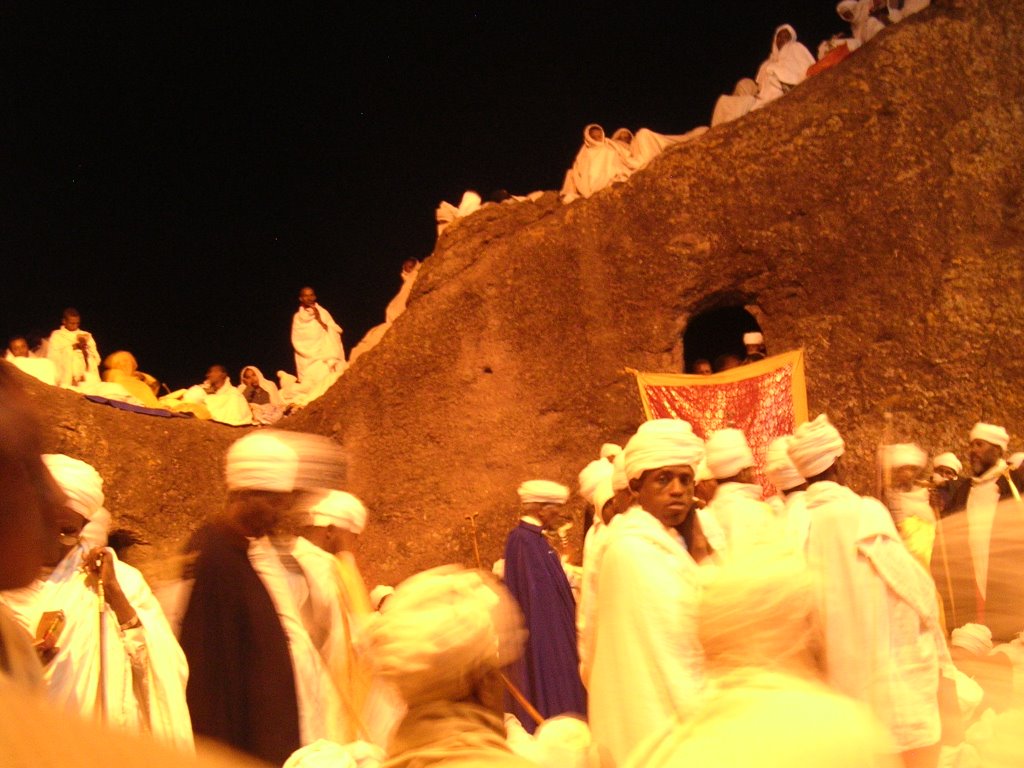
Melkem Addis Amet! Today is the beginning of 1999 in Ethiopia. In celebration, I give you one of my favourite photos of Ethiopia--it's picture of Christmas celebrations in Lalibela.
For those of you who are unfamiliar with the Ethiopian calendar, it's based on the Julian calendar, unlike our western Gregorian calendar. There are twelve months, each with 30 days, and a thirteenth month with between five and six days--depending on whether or not it's a leap year. Today marks the celebration of Ekutatash, and the first day of Meskarem. It also, however, marks the beginning of the big countdown to Y2K for Ethiopians.
Multi-billionaire Al-Amoudi, who, many would argue, might be better off spending his money on more significant projects, is installing giant countdown clocks in Ethiopia, readying the country for its entry into the next millenium. Rastafari have told me that we should pay attention to this, the "real" year 2000. Hmmm...
Hopefully next year I'll be there to see just what might happen.

Saturday, September 09, 2006

Now this for Vero

Not as nice as yours, but it's an attempt.

Friday, September 08, 2006

Tomatoes in Chelsea


I took this for Aurora.

Thursday, September 07, 2006

Talking Will Holland's ear off Part 1

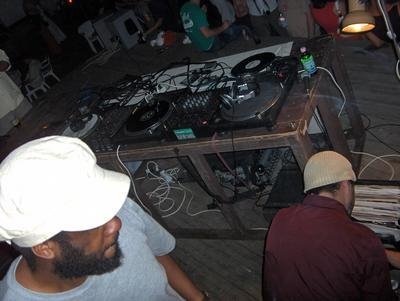
In the above photo, which, admittedly, tends to showcase the turntables more than anything, is Andy Williams at left and Will "Quantic" Holland at right. I just sorta liked the photo-thanks to cratesoul.kepeim.hu. I think I want to go to Hungary now.
Anyhow, as promised, here is the interview I did with Will (using the first name sorta takes away from my journalistic mystique, eh?) this past weekend. I'm cutting it in two because it's quite long. An extremely short version appears in the Montreal Mirror today. I haven't really edited much of this, so I sound pretty blather-y, if that's a word. I tend to get a little excited when I get to talk to people who've been to Ethiopia. I'm a dork that way. Anyhow, on with the show. If you don't know who Quantic is and what he does, you should. His music is simply terrific, and he seems a darned fine fellow to boot.

EM: I see you as taking the concept of crate digging to a whole other level. What do you look for?

Q: I think that the basic form of crate digging where it’s basically looking for breaks, drum breaks to loop up or to sample and things, and then I think that once you do that for a whole [laughs] you just get in to music more. And you get into it a little more deeply; you get in to all kinds of music, regardless as to whether it has a drum break in it or whether it’s a funky record or not. So myself, and probably Miles [Claret, of Soundway records] also, are both looking for quite eccentric records, and definitely dance records. Something that you can play out in a club and it will go down well and be played up to good effect, but also something a little eccentric so it could be a calypso record, a salsa record, an afrobeat record, but it has to have something interesting about it.

EM: You travel around a lot. It seems like you want to go to the source of the music you like—take, for instance, Ethiopia’s Mulatu Astetke.

Q: Well I guess—I’m actually sitting here with Miles now—and I guess the thing is, all of these things start off in record room, it a kitchen, listening to a record, and going “Oh my God! This is amazing. How was this made? Who made it? Where do they come from?” Miles had of those moments a few years back and said, right, I’m going to go to Ethiopia and he bought the ticket to Ethiopia. And we were just sitting around one night and [Miles] told me he’d gone pretty briefly, but he’d found some nice records. We just decided to go again, with the premise of trying to track down Mulatu for an interview. So we interviewed him for Wax Poetics. And also we wanted to do a potential sounding out of whether we could do some recording over there. Which actually, we haven’t done yet. It’s all kind of gone a little bit wrong. I mean, it’s gone well for Mulatu, because he’s got this “Broken Cloud” track and he’s got a lot of interest through that. But it’s becoming increasingly hard to pin him down, to set dates, because he’s a very busy man. But as far as getting out there, it’s just the case of buying a ticket and just kind of winging it, really. [laughs] Actually, Mulatu really took us under his wing.

EM: Ethiopians tend to be nice like that!

Q: Yeah. You know, all these places, some are heavy places to go to, but people are really friendly. I think it’s like anything—when somebody’s taken an interest in your culture, unless you’re robbing or something, but this is something that we are promoting and trying to keep the knowledge of this music alive. A lot of these forms of music are dying out. A lot of people don’t want to being learning to play drums in Africa, they want to use a drum machine.

EM: Vincent Kenis, who’s worked with Congolese musicians, most famously, Konono No. 1, he said that in Kinshasa, none of the young people really want to listen to the traditional music. In Ethiopia, it’s the same, everyone wants what’s new—the latest Amharic pop music. When I’ve asked kids about Mulatu Astake, they’ll say, “Oh, my parents like him, we like Teddy Afro.” In Ghana as well, there are not a lot of people listening to the tracks found on Soundway’s compilations. It’s like you’re resurrecting the past—do you feel that you should focus more on contemporary tunes?

Q: For me, I’m interested in real music and music played in the room with an atmosphere to it. Just because I like Puerto Rican Rhumba records from the 60s doesn’t mean I have to like reggaeton. For me, the two things are so far removed. [Music] just becomes a generic culture that doesn’t have any roots in [a cultures] own heritage. With reggaeton, a lot of the time it is a just a dancehall riddim. There are interesting things, modern Caribbean records; I have found some nice modern Ethiopian stuff, but only a few. To be honest, I really like drummers and I really like live music. And I like things nasty, kind of messed up, in a way that it gives it character. And I think what you’ve got to remember with these older recordings is that they were made in really unique times.

EM: Yes.

Q: You had army bands and military bands, police bands—especially in Ethiopia. All these bands were part of clubs and I don’t know whether you’d get a recording now from twenty Nigerian policemen, playing a funk track or an afrobeat track or a high life track. I don’t think that’s happening any more. I think it’s about getting kinds who are into music aware of that olds stuff and how they can add that into their music and not do some kind of “Mr American” style thing, trying to be a rap star. Instead, be more in keeping with the music that they’ve come from.

EM: In Ethiopia, even though kids like modern stuff, there is still quite an appetite for not Mulatu, but very traditional Ethiopian music. Played on the masinko and krar, in a pentatonic mode that’s really different than what Westerners are used to listening to.

Q: Yeah, I like that stuff! [laughs] I remember I went with Miles and Mulatu to this restaurant in Addis and they had the traditional players playing that stuff on krar and we had to get up and do this dance, you know, with the shoulders.

EM: Of course!

Q: And Miles was thinking, god, we came to find Mulatu and here we are shaking our shoulders to the krar. I think though, it’s interesting and it’s all part of the music I’m interested in and so is Miles as well, is that point where all these forms of folk music were becoming modernized. Maybe they were trying to be a little more commercial, trying to be a little bit more turned into a product.

EM: It’s as if you’re looking for links. With Mulatu, you do hear the minor strains so common to Ethiopian music, mixed with other influences. With early calypso, you hear the traditional chanting. It’s almost like being a musical archeologist.

Q: Definitely. I think it’s just looking to see what spices were turned into pop a long the way. With Mulatu, you can hear Chinese music in there and you can hear all the Puerto Rican rhythms that he picked up in New York. And you can hear the fact that he was in London playing with jazz guys. I love going on these trips because you hear just the strangest music.

Part 2 to come...

Sunday, September 03, 2006

Thank-you Heather

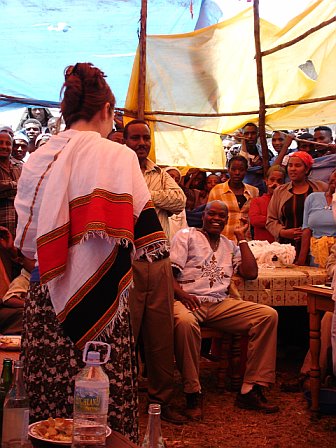
Here's a photo of me giving a speech in Amharic--the second speech I've made in the language. It appears from the photo, taken by Heather (there's a link to her blog at left), that either the content of the speech or my brutal pronounciation is particularly hilarious. All this to say that I think it's pretty indicative of something...
Coming up this week is a long version (sorry Julie!) of an interview I did with Quantic. Sure, I may have forced him to talk a little excessively about Ethiopia, but those who know me, you gots to know I've got a little thing for that country and any one who happens to have visted there. Any opportunity to talk about it...gawd, if this blog is any indication, I should perhaps keep my flaming mouth shut. You'll again witness this particular problem I have probably on Thursday or Friday. Until such time, buy Quantic's new album, or any of his albums, or Mulatu Astetke's albums. They're all quite great.